
CRG Research Training Program 2026 in Spain – Complete Guide
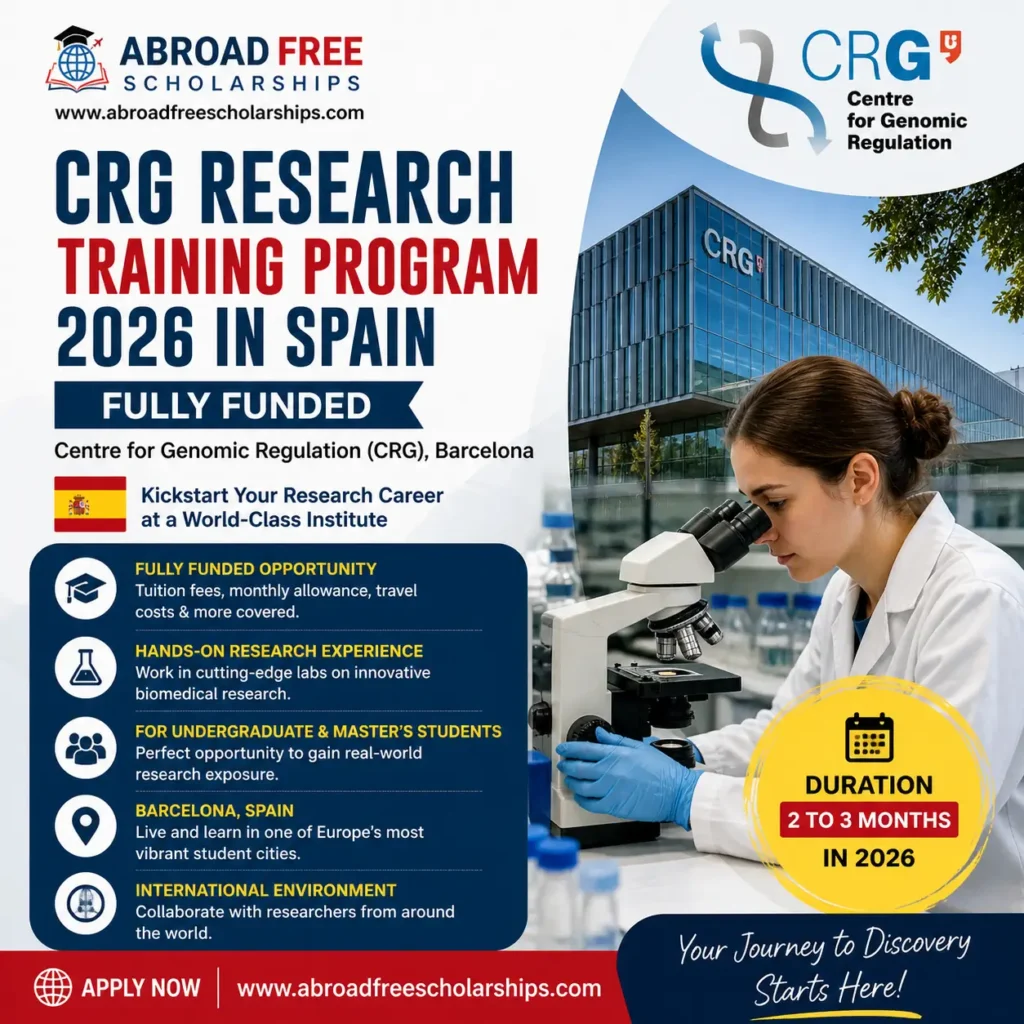
The CRG Research Training Program 2026 is a prestigious, fully funded research training opportunity hosted by the Centre for Genomic Regulation (CRG) in Barcelona, Spain. It gives undergraduate and master’s students from all countries a chance to gain real scientific experience in internationally recognized laboratories.
Program Overview
- Host Institution: Centre for Genomic Regulation (CRG), Barcelona, Spain :contentReference[oaicite:2]{index=2}
- Duration: Up to 5 months
- Program Type: Fully Funded Research Training
- Eligibility: Bachelor’s & Master’s students from all nationalities
- Application Deadline: Open throughout the year on a rolling basis
Who Should Apply?
This program is ideal for students who:
- Are currently enrolled in an undergraduate or master’s degree in science, engineering, or related fields.
- Want to build a research career or strengthen their CV for graduate studies.
- Have a strong interest in laboratory work, data analysis, and collaborative scientific environments.
Why Choose the CRG Research Training Program?
The CRG Research Training experience stands out for multiple reasons:
- Fully Funded: All major expenses are covered, allowing students to concentrate on research without financial burden.
- International Exposure: Participants join diverse scientific teams and experience global research culture.
- Hands-On Research: Work directly with active research projects and cutting-edge lab technologies.
- Professional Mentorship: Receive guidance from experienced researchers and group leaders.
- Enhanced Career Prospects: The experience strengthens applications for postgraduate studies and research careers.
Program Benefits & Financial Coverage
The CRG Research Training Program offers strong financial support to participants:
- Monthly Stipend: €600 per month (gross) for up to five months.
- Travel Allowance:
- Up to €800 for round-trip flights from outside Europe.
- Up to €300 for flights from within Europe.
- Access to Seminars and Facilities: Participants can attend scientific seminars and make use of CRG’s advanced research infrastructure.
- No Application Fee: The program charges no fee to apply.
Research Areas and Training Details
Although specific courses are not a formal part of the program, participants engage in real research tasks in active CRG laboratories and gain exposure to scientific methods in areas such as:
- Genomics and Gene Regulation
- Molecular & Cell Biology
- Bioinformatics and Computational Biology
- Systems Biology and Biomedical Data Analysis
- Cancer Biology and Disease Research
Students work under the guidance of a principal investigator and team, contributing to ongoing research while developing laboratory and analytical skills.
Original Step-by-Step Application Guide for the CRG Research Training Program 2026
The CRG Research Training Program follows a research-group-based selection process. Applicants are encouraged to contact a suitable research group directly and demonstrate how their academic background aligns with the laboratory’s research objectives.
- Research Available CRG Laboratories: Review the research groups and identify laboratories that match your academic interests and career goals.
- Study the Research Project Carefully: Read recent publications, ongoing projects, and research themes of the selected laboratory before preparing your application.
- Prepare a Targeted Motivation Letter: Explain why you are interested in that specific laboratory, how your academic background matches the project, and what skills you hope to gain.
- Update Your Academic CV: Include research experience, laboratory skills, academic achievements, publications, certifications, and relevant coursework.
- Request a Strong Reference Letter: Ask a professor or supervisor who can discuss your academic abilities, research potential, and work ethic.
- Collect Official Academic Transcripts: Ensure transcripts are clear, updated, and available in English whenever possible.
- Contact the Group Leader Professionally: Send a concise email introducing yourself and attach all required documents in PDF format.
- Monitor Email Communication: Respond promptly to requests for additional information, interviews, or clarifications.
- Prepare for a Potential Interview: Review your academic background, research interests, and the laboratory’s recent work.
- Complete Travel and Visa Arrangements: Once selected, begin preparing accommodation, travel bookings, and visa documentation as early as possible.
Common Mistakes to Avoid When Applying
Many qualified students are rejected because of avoidable errors rather than academic weaknesses. Avoid the following mistakes:
- Sending a generic motivation letter to multiple laboratories without personalization.
- Applying without reviewing the research interests of the selected group.
- Submitting an outdated CV that lacks research experience, projects, or technical skills.
- Using an unprofessional email address or poorly written email communication.
- Ignoring document formatting and submitting incomplete application materials.
- Failing to explain how your academic background aligns with the laboratory’s research area.
- Waiting until the last minute to request recommendation letters.
- Providing vague career goals without demonstrating a genuine interest in scientific research.
- Overstating skills that cannot be demonstrated during an interview.
- Not proofreading documents for grammar, spelling, and formatting errors.
Expert Tip: Selection committees often prefer a well-prepared and focused application over one that simply lists many achievements without a clear connection to the research project.
Tips for Writing a Strong Motivation Letter for the CRG Research Training Program
Your motivation letter is one of the most important parts of the application because it demonstrates your research interest and suitability for the selected laboratory.
Recommended Structure
- Introduction: Briefly introduce yourself, your degree program, and your research interests.
- Why CRG? Explain why the Centre for Genomic Regulation and the selected research group appeal to you.
- Academic Background: Highlight relevant coursework, projects, laboratory experience, and technical skills.
- Research Interests: Demonstrate knowledge of the laboratory’s work and explain how it connects with your future goals.
- Career Objectives: Describe how the CRG experience will contribute to your academic and professional development.
- Conclusion: Express enthusiasm, appreciation, and readiness to contribute to the research team.
Writing Tips
- Keep the letter between 500 and 800 words.
- Focus on research motivation rather than financial need.
- Mention specific CRG research areas that interest you.
- Use clear, professional, and concise language.
- Support claims with examples from coursework, projects, or research experiences.
- Demonstrate curiosity, critical thinking, and a willingness to learn.
How to Get an Accommodation Voucher as an International Student
Although accommodation support policies may vary, international students participating in research programs in Spain can explore several legitimate options to reduce housing expenses.
- Request Guidance from the Host Laboratory: Many research groups can recommend trusted student housing providers or university residences.
- Check International Student Services: Some institutions collaborate with accommodation partners that offer discounted rates.
- Explore Student Residence Partnerships: Student housing companies occasionally provide promotional vouchers and seasonal discounts.
- Apply Early: Early applicants often receive the best accommodation offers and availability.
- Join Official Student Communities: Accepted participants frequently share accommodation discounts and housing recommendations through student groups.
- Look for Mobility Grants: Certain educational organizations and foundations provide housing support for international mobility programs.
Important: Always verify accommodation providers through official channels before making any payments or reservations.
Complete Breakdown of the CRG Research Training Program Interview Process
Interview formats may vary between research groups; however, most successful applicants report a research-focused discussion rather than a formal examination.
Stage 1: Initial Screening
- Review of motivation letter, CV, transcripts, and recommendation letter.
- Assessment of academic background and alignment with the laboratory.
Stage 2: Online Interview Invitation
- Shortlisted candidates may be invited to an online meeting.
- Interviews are commonly conducted via Zoom, Google Meet, or similar platforms.
Stage 3: Academic Discussion
- Questions about your degree program and academic achievements.
- Discussion of research projects, coursework, and laboratory experience.
- Evaluation of problem-solving and critical-thinking abilities.
Stage 4: Research Interest Assessment
- Why did you choose this research group?
- Which CRG projects interest you most?
- What research topics would you like to explore in the future?
Stage 5: Communication and Team Fit
- Assessment of English communication skills.
- Evaluation of teamwork, adaptability, and willingness to learn.
- Discussion of availability and commitment during the program period.
Interview Preparation Tips
- Review your CV thoroughly before the interview.
- Read recent publications from the selected laboratory.
- Prepare concise explanations of previous projects.
- Be ready to discuss your long-term research goals.
- Prepare thoughtful questions about the research environment and mentorship opportunities.
Final Advice: Interviewers are usually looking for motivation, curiosity, and research potential rather than advanced expertise. Demonstrating enthusiasm for scientific research can significantly strengthen your application.
Eligibility Criteria
- Open to students of any nationality.
- Must be enrolled in a Bachelor’s or Master’s program.
- Students must obtain acceptance from a CRG laboratory or supervisor.
- Good proficiency in English is recommended for lab communication.
Required Documents for Application
- Curriculum Vitae (CV) or Resume.
- Motivation Letter explaining research interests.
- Academic Transcripts or university record.
- Reference Letter (from a professor or supervisor).
How to Apply
- Review available research projects and identify areas matching your academic background.
- Prepare all required documents.
- Contact your chosen research group leader directly, submitting your application and expressing interest.
- Once accepted, complete any institutional paperwork or agreements.
Applications are accepted year-round because positions are selected on a rolling basis.
Start Your Research Journey at CRG, Barcelona!
Unlock world-class research experience at the Centre for Genomic Regulation (CRG).
Join cutting-edge laboratories, work with international experts, and take the next step
toward a successful scientific career. Explore the program and apply today.
Apply Now – Begin Your Training at CRG
Limited research placements available. Early applications recommended.