
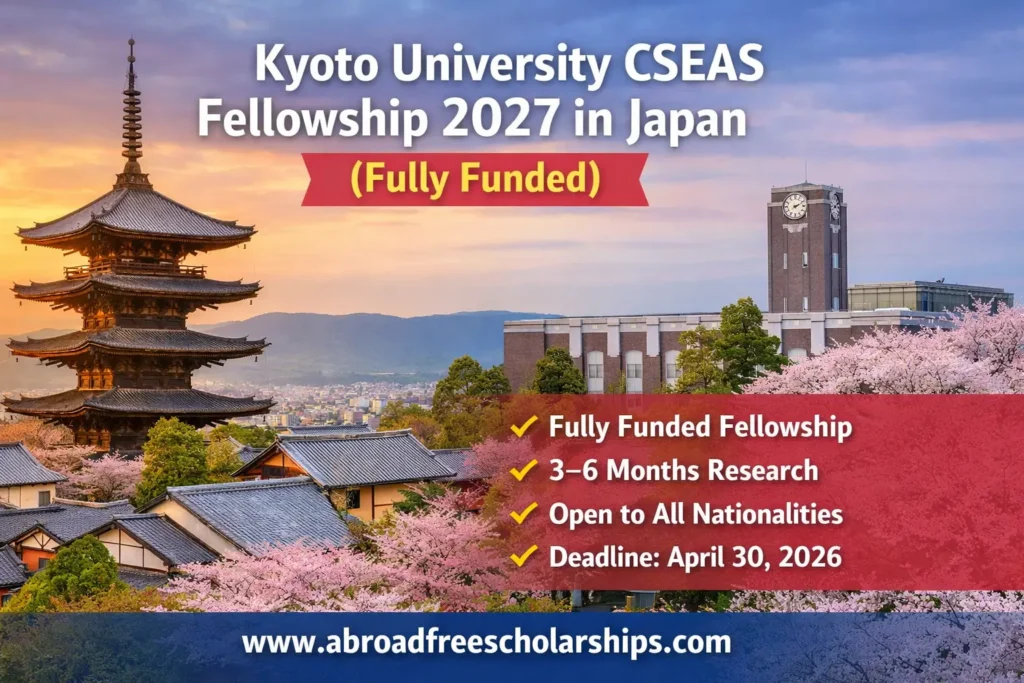
Kyoto University CSEAS Fellowship 2027 in Japan (Fully Funded)
The Kyoto University CSEAS Fellowship 2027 is a prestigious fully funded research opportunity in Japan for international scholars. Hosted by the Center for Southeast Asian Studies (CSEAS), this fellowship allows researchers to spend 3 to 6 months in Kyoto focusing on academic research, collaboration, and scholarly development.
Overview
- Host University: Kyoto University
- Host Country: Japan
- Program Type: Visiting Research Fellowship
- Duration: 3 to 6 Months
- Funding: Fully Funded
- Eligible Countries: All Nationalities
- Deadline: April 30, 2026
About the Fellowship
The CSEAS Fellowship is designed for experienced scholars who wish to conduct independent research in a dynamic academic environment. The Center for Southeast Asian Studies at Kyoto University is known for its multidisciplinary approach and has hosted over 450 scholars globally.
Selected fellows will have access to research facilities, academic networks, and opportunities to participate in seminars, workshops, and conferences.
Fellowship Benefits
- Monthly stipend for living expenses
- International travel expenses covered
- Research funding support
- Access to world-class research facilities
- Opportunity to attend conferences and workshops
- Networking with international scholars
- Support for domestic travel in Japan
Eligibility Criteria
- Applicants must be accomplished scholars with strong academic backgrounds
- Must generally be under 65 years of age
- PhD degree is required (exceptions possible with approval)
- Not open to current graduate or postdoctoral students
- Librarian position available for experienced professionals
- Previous fellows can reapply after 6 years
Original Step-by-Step Application Guide for the Kyoto University CSEAS Fellowship
The Kyoto University CSEAS Fellowship is highly competitive and attracts experienced researchers,
academics, policy professionals, journalists, NGO practitioners, and specialists working on Southeast Asia
and related regional studies. Successful applicants typically spend significant time preparing a strong,
research-focused application rather than rushing through the process.
- Step 1: Study the Fellowship Objectives
Understand the mission of the Center for Southeast Asian Studies (CSEAS) and ensure your research interests align with its multidisciplinary and regional focus. - Step 2: Review Eligibility Requirements Carefully
Confirm that you meet the academic and professional requirements before beginning your application. - Step 3: Identify a Research Gap
Strong applicants usually propose research that contributes new perspectives rather than repeating existing studies. - Step 4: Develop a Clear Research Proposal
Outline your objectives, methodology, expected outcomes, and how Kyoto University’s resources will support your work. - Step 5: Update Your Academic CV
Highlight publications, conference presentations, research grants, leadership roles, and professional achievements. - Step 6: Secure Strong Recommendation Letters
Choose referees who can discuss your research capabilities, academic contributions, and professional impact. - Step 7: Demonstrate Why Kyoto University Is Essential
Explain specifically how CSEAS faculty, archives, libraries, or research networks will contribute to your project. - Step 8: Proofread All Documents Thoroughly
Check consistency in dates, publications, project titles, and research objectives. - Step 9: Submit Before the Deadline
Early submission allows time to resolve technical issues and demonstrates professionalism. - Step 10: Prepare for Possible Follow-Up Communication
Keep copies of all submitted materials and be ready to discuss your research proposal in greater detail.
Common Mistakes to Avoid When Applying for the Kyoto University CSEAS Fellowship
Many highly qualified candidates are unsuccessful because they make avoidable application errors. The following mistakes frequently weaken otherwise strong applications:
- Submitting a generic research proposal that could be used for any fellowship.
- Failing to demonstrate a clear connection between the proposed research and CSEAS priorities.
- Writing overly ambitious projects that cannot realistically be completed within the fellowship period.
- Providing vague research objectives without measurable outcomes.
- Ignoring formatting and documentation requirements.
- Submitting outdated academic CVs.
- Using weak recommendation letters that lack specific examples of research excellence.
- Overemphasizing personal benefits while neglecting scholarly contributions.
- Not explaining why Kyoto University is the ideal host institution.
- Waiting until the final days before the deadline to complete the application.
Expert Tip: Reviewers often prioritize clarity, feasibility, originality, and academic impact over lengthy or overly complex proposals.
Tips for Writing a Strong Motivation Letter for the Kyoto University CSEAS Fellowship
Unlike many scholarship programs, the CSEAS Fellowship places strong emphasis on research quality,
academic collaboration, and intellectual contribution. Your motivation letter should clearly demonstrate
why your project deserves support and why Kyoto University is the ideal environment for your work.
What Your Letter Should Cover
- Your academic and professional background.
- The significance of your research topic.
- The gap your research intends to address.
- Why CSEAS is uniquely suited to support your project.
- Expected contributions to your field of study.
- How collaboration with CSEAS researchers will strengthen your work.
Recommended Structure
- Introduction: Brief personal and professional introduction.
- Research Background: Explain your research experience and achievements.
- Research Proposal Overview: Present your proposed project clearly.
- Connection to CSEAS: Explain why Kyoto University is essential for your work.
- Future Impact: Describe how the fellowship will advance your research and professional goals.
- Conclusion: Reaffirm your commitment and appreciation.
Writing Recommendations
- Focus on evidence rather than claims.
- Use specific examples from previous research projects.
- Maintain a formal academic tone.
- Avoid generic statements about studying in Japan.
- Clearly explain the broader significance of your research.
How to Get an Accommodation Voucher as an International Research Fellow in Japan
Many international researchers overlook housing support opportunities that may be available through universities,
research centers, and fellowship host institutions.
Potential Sources of Accommodation Support
- Host Institution Housing Programs: Universities often maintain guest houses or researcher residences.
- International Research Offices: These offices may negotiate discounted accommodation rates for visiting scholars.
- Research Collaboration Grants: Some research grants include separate housing allowances.
- Partner Accommodation Providers: Universities frequently collaborate with nearby hotels and serviced apartments.
- Academic Conference Support: Scholars attending affiliated conferences may receive temporary accommodation assistance.
- Embassy and Cultural Exchange Programs: Certain exchange initiatives provide supplementary housing benefits.
Practical Advice
- Contact the fellowship coordinator immediately after selection.
- Ask whether guest researcher housing is available.
- Request information regarding discounted accommodation partnerships.
- Explore university-managed residences before booking private housing.
- Maintain copies of accommodation receipts if reimbursement is possible.
Complete Breakdown of the Fellowship Interview Process
While the Kyoto University CSEAS Fellowship selection process is primarily research-based, applicants should still be prepared for academic discussions, clarification requests, or interview-style evaluations during the selection process.
Stage 1: Application Screening
- Eligibility verification.
- Academic qualification assessment.
- Research proposal evaluation.
- Review of publications and professional achievements.
Stage 2: Research Quality Assessment
- Originality of the proposed research.
- Feasibility within the fellowship period.
- Potential scholarly contribution.
- Alignment with CSEAS research priorities.
Stage 3: Academic Discussion or Interview (If Conducted)
Applicants may be asked questions such as:
- Why is your research important?
- How does your project contribute to existing scholarship?
- Why did you choose Kyoto University?
- What outcomes do you expect from the fellowship?
- How will you collaborate with CSEAS researchers?
- What challenges do you anticipate during the research process?
Stage 4: Final Evaluation
- Research excellence.
- Academic impact.
- Professional achievements.
- Potential for international collaboration.
- Contribution to CSEAS scholarly activities.
Interview Preparation Checklist
- Review your research proposal thoroughly.
- Prepare concise explanations of your methodology.
- Study recent CSEAS publications and projects.
- Practice discussing your research with non-specialist audiences.
- Prepare examples of previous academic contributions and achievements.
Final Recommendation: The strongest candidates demonstrate not only research excellence but also a clear vision for how their work will contribute to international scholarship and the broader academic community.
Required Documents
- Completed online application form
- Curriculum Vitae (maximum 5 pages)
- Research Plan (maximum 2 pages)
- Two recommendation letters
Application Process
- Complete the online application form
- Prepare required documents in PDF format
- Email documents to the official CSEAS email
- Ask referees to submit recommendation letters
Important Dates
- Application Deadline: April 30, 2026
- Result Announcement: End of July 2026
- Fellowship Start: From March 2027 onwards
Why Apply?
- Fully funded research stay in Japan
- Access to Kyoto University’s academic resources
- Collaborate with global researchers
- Enhance your academic profile
Apply Now for Kyoto University CSEAS Fellowship 2027
Ready to take your research career to the next level? Don’t miss this fully funded opportunity to join Kyoto University in Japan and collaborate with world-class scholars.
- ✔ Fully Funded Research Opportunity
- ✔ International Scholars Welcome
- ✔ Study & Research in Japan
Deadline: April 30, 2026
Visit the official website for complete details and application guidelines.