
University of Sydney Scholarships 2026 in Australia (Fully Funded)
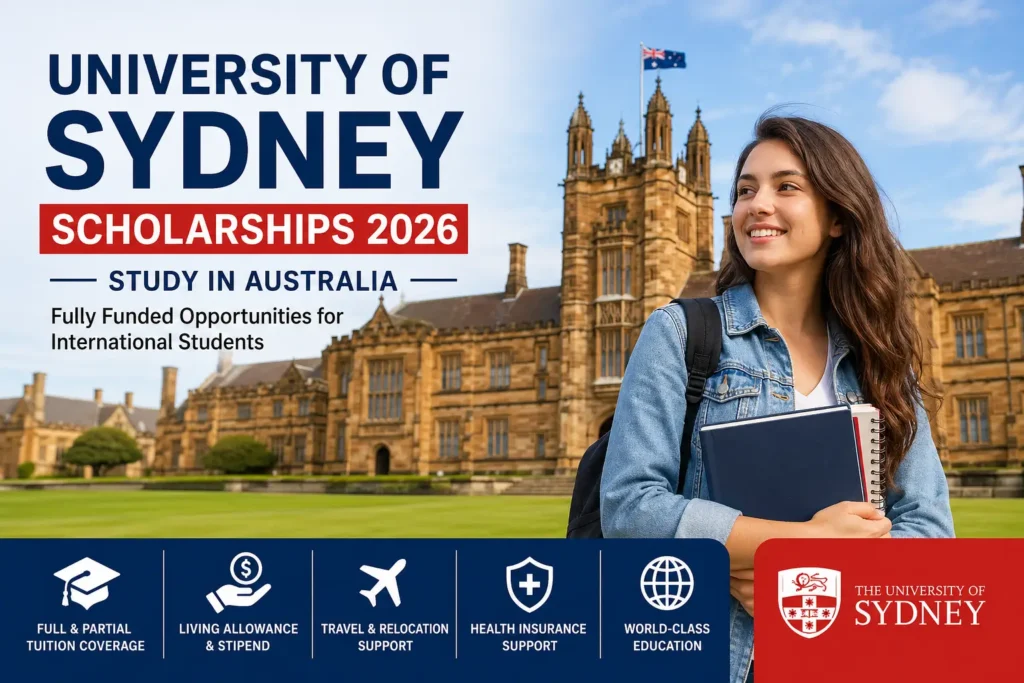
The University of Sydney Scholarships 2026 offer outstanding opportunities for international students to pursue undergraduate, master’s, and PhD degrees in Australia. These scholarships are designed to support high-achieving students by providing financial assistance, including tuition coverage and living expenses.
The University of Sydney is one of the top-ranked universities globally and offers a wide range of scholarships for international students based on academic merit and research potential.
Scholarship Overview
- Host Country: Australia
- University: University of Sydney
- Degree Levels: Bachelor’s, Master’s, PhD
- Eligible Nationalities: All International Students
- Funding Type: Fully Funded / Partially Funded
Scholarship Benefits
The University of Sydney offers multiple scholarships with different benefits. Depending on the program, benefits may include:
- Full or partial tuition fee coverage
- Living allowance for postgraduate research students
- Scholarship value up to $60,000 for coursework programs
- Up to 100% tuition fees covered for selected undergraduate programs
- Travel and relocation allowance (for research programs)
- Health insurance support (in some cases)
- Access to world-class research facilities
Eligibility Criteria
- Must be an international student
- Must have applied for an eligible degree program
- Strong academic record and achievements
- Meet English language requirements
- Fulfill specific scholarship requirements
Original Step-by-Step Application Guide Based on Real Applicant Experiences
Many successful international applicants report that early preparation and careful document organization significantly increase their chances of receiving admission and scholarship consideration. The following practical application roadmap is based on common experiences shared by previous scholarship recipients and international students.
- Research the Appropriate Scholarship Category
- Identify whether you are applying for Undergraduate, Coursework Master’s, Research Master’s, or PhD programs.
- Check if your preferred program qualifies for automatic scholarship consideration or requires a separate application.
- Prepare Academic Documents Early
- Official transcripts and degree certificates.
- Updated CV or Resume.
- English language test results (IELTS, TOEFL, or equivalent if required).
- Research proposal for research-based degrees.
- Create a Strong Applicant Profile
- Highlight leadership activities, research experience, publications, internships, and community engagement.
- Demonstrate achievements beyond academic grades.
- Submit Admission Application Before Scholarship Deadlines
- Most scholarship opportunities are linked to admission applications.
- Applying early provides access to more scholarship rounds and funding opportunities.
- Monitor Email Communications Regularly
- Respond promptly to document verification requests.
- Check spam and promotions folders frequently.
- Prepare Financial and Visa Documents in Advance
- Keep passport, financial statements, and identification documents updated.
- This can save valuable time after receiving an offer.
Common Mistakes to Avoid When Applying for Scholarships
Scholarship reviewers often reject otherwise qualified applicants because of avoidable mistakes. To maximize your chances, avoid the following:
- Submitting incomplete application forms.
- Uploading outdated or unofficial academic transcripts.
- Using a generic motivation letter for multiple scholarships.
- Ignoring specific eligibility requirements.
- Applying close to the deadline and facing technical issues.
- Failing to demonstrate academic goals and career objectives.
- Submitting poorly formatted CVs with inconsistent information.
- Providing weak or generic recommendation letters.
- Not proofreading documents for spelling and grammar errors.
- Missing scholarship-specific document requirements.
Tips for Writing the Motivation Letter for the University of Sydney Scholarships
A strong motivation letter should clearly explain why you are an ideal candidate and how studying at the University of Sydney aligns with your academic and professional goals.
Recommended Structure
- Introduction: Briefly introduce yourself and your chosen degree program.
- Academic Background: Highlight academic achievements and relevant coursework.
- Research or Professional Experience: Explain experiences that prepared you for advanced study.
- Why the University of Sydney: Mention faculty expertise, research facilities, academic reputation, or specific courses.
- Future Career Goals: Explain how the scholarship will help create long-term impact in your field.
- Conclusion: Reinforce your commitment and appreciation for the opportunity.
What Scholarship Reviewers Want to See
- Clear academic direction.
- Evidence of leadership potential.
- Research capability and critical thinking.
- Commitment to contributing to society or industry.
- Genuine interest in the University of Sydney.
How to Get an Accommodation Voucher as an International Student
Although accommodation vouchers are not automatically provided to all scholarship recipients, international students may access housing discounts, temporary accommodation support, and promotional accommodation offers through several channels.
- Apply for University-managed student residences as early as possible.
- Monitor official housing announcements and orientation programs.
- Join international student welcome initiatives that occasionally provide housing incentives.
- Check scholarship award letters for relocation or settlement support.
- Contact the university accommodation office regarding available housing promotions.
- Participate in international student ambassador or leadership programs that may include housing benefits.
- Seek accommodation partnerships offered by student organizations and approved housing providers.
Additional Cost-Saving Strategies
- Book accommodation several months before arrival.
- Consider shared housing options.
- Explore student-exclusive housing platforms.
- Attend pre-arrival webinars where housing discounts are sometimes announced.
Complete Breakdown of the Scholarship Interview Process
Some competitive scholarships, research programs, and funding schemes may require an interview stage. While interview formats vary by scholarship type, applicants can generally expect the following process.
Stage 1: Application Screening
- Review of academic achievements.
- Evaluation of motivation letter and CV.
- Assessment of research potential and leadership qualities.
Stage 2: Interview Invitation
- Selected candidates receive email invitations.
- Interviews are commonly conducted online through video conferencing platforms.
Stage 3: Interview Questions
Common interview topics include:
- Tell us about yourself.
- Why did you choose the University of Sydney?
- Why should you receive this scholarship?
- What are your long-term career objectives?
- Describe a challenge you overcame.
- How will you contribute to the university community?
- What impact do you hope to create after graduation?
Stage 4: Evaluation Criteria
- Academic excellence.
- Communication skills.
- Leadership potential.
- Research capability.
- Professional maturity.
- Alignment with scholarship objectives.
Interview Success Tips
- Research the scholarship thoroughly.
- Review your submitted application documents.
- Prepare concise and evidence-based answers.
- Practice speaking confidently in English.
- Use specific examples from academic, professional, or volunteer experiences.
- Prepare thoughtful questions for the interview panel.
Required Documents
- Academic transcripts
- Curriculum Vitae (CV)
- Statement of Purpose (SOP)
- Letters of Recommendation
- English proficiency test results (IELTS/TOEFL if required)
How to Apply for University of Sydney Scholarships 2026
- Choose Your Program: Select a degree program offered by the University of Sydney.
- Apply for Admission: Submit an online application through the official university portal.
- Check Scholarship Eligibility: Review available scholarships related to your program.
- Automatic Consideration: Some scholarships are awarded automatically after admission
- Submit Additional Applications: For certain scholarships, submit a separate application.
- Wait for Results: Successful applicants will be notified via email.
Application Deadlines
Deadlines vary depending on the scholarship and intake. For example, some scholarships for 2026 have multiple rounds between February and May . Applicants are advised to apply early.
Why Study at the University of Sydney?
- Ranked among the top universities worldwide
- Globally recognized degrees
- Diverse international student community
- Strong research and innovation environment
Frequently Asked Questions (FAQs)
1. Are University of Sydney Scholarships 2026 fully funded?
Yes, some scholarships are fully funded covering tuition fees, living expenses, and additional benefits, while others are partially funded.
2. Do I need IELTS for University of Sydney scholarships?
Yes, most programs require proof of English proficiency such as IELTS or TOEFL unless exempted.
3. Can I apply without an admission offer?
No, you generally need to apply for admission first. Some scholarships automatically consider applicants after receiving an offer.
4. What is the maximum scholarship value?
The scholarship value can go up to $60,000 for certain programs
5. Are scholarships available for undergraduate students?
Yes, undergraduate scholarships are available, including those covering 100% tuition fees for selected programs
Apply for University of Sydney RTP Scholarships 2026
Don’t miss this opportunity to study in Australia with a fully funded scholarship.
The Australian Government Research Training Program (RTP) at the University of Sydney
covers tuition fees, living expenses, and more for international students.