
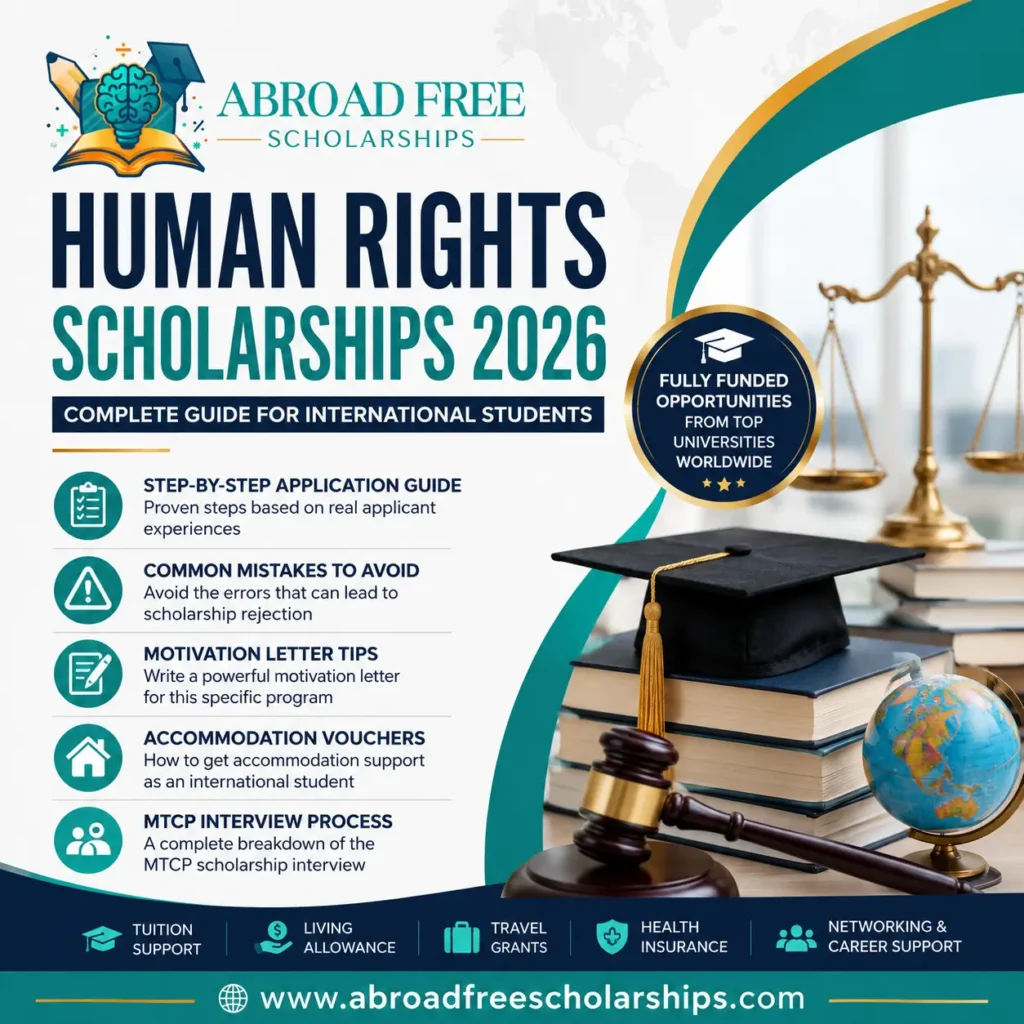
Human Rights Scholarships: The Complete Guide for International Students
Human rights education has become one of the most impactful academic pathways for students interested in advocacy, international law, humanitarian action, social justice, public policy, and global development. Universities and institutions worldwide offer a wide range of scholarships specifically designed for students pursuing degrees in human rights, international law, humanitarian studies, and related disciplines.
According to Human Rights Careers, opportunities are available through institutions such as Columbia University, the University of Oxford, Leiden University, London School of Economics, York University, Lund University, and many other globally recognized institutions offering partial and fully funded scholarships for qualified candidates.
This guide provides a detailed overview of scholarship opportunities, application strategies, interview preparation, accommodation support, and practical advice based on successful applicant experiences.
Understanding Human Rights Scholarships
Human rights scholarships are financial awards designed to support students who demonstrate academic excellence, leadership potential, commitment to social justice, and a strong interest in advancing human rights causes globally.
Common Scholarship Benefits
- Full or partial tuition fee coverage
- Monthly living stipends
- Research grants
- Travel allowances
- Health insurance support
- Accommodation assistance
- Conference participation funding
- Internship and networking opportunities
Popular Human Rights Scholarship Providers
- University of Oxford Human Rights Scholarships
- Columbia Law School Human Rights LL.M. Fellowship
- London School of Economics Scholarships
- Leiden University Excellence Scholarships
- Geneva Academy Scholarships
- University of Melbourne Australia Awards
- Lund University Global Scholarship Programme
- York University Applied Human Rights Scholarships
Many of these scholarships provide tuition support, living allowances, travel grants, and additional academic benefits depending on the program and funding source.
Step-by-Step Scholarship Application Guide Based on Real Applicant Experiences
One of the biggest reasons scholarship applications fail is poor planning. Successful applicants often begin preparations six to twelve months before the application deadline.
Step 1: Research Programs Thoroughly
- Identify programs aligned with your career goals.
- Review eligibility requirements carefully.
- Check language requirements.
- Understand funding coverage.
- Review previous scholars and alumni profiles.
Step 2: Build a Strong Academic Profile
Many scholarship committees assess:
- Academic performance
- Research achievements
- Volunteer work
- Leadership experience
- Community engagement
Step 3: Prepare Required Documents Early
- Academic transcripts
- Degree certificates
- Curriculum Vitae (CV)
- Passport copy
- Language proficiency test results
- Recommendation letters
- Motivation letter
Step 4: Contact Referees in Advance
Applicants who secure strong recommendation letters often approach professors and supervisors at least two months before deadlines.
Step 5: Customize Every Application
Avoid submitting generic statements. Scholarship reviewers can quickly identify recycled applications.
Step 6: Submit Before the Deadline
Successful applicants frequently submit applications several days before the final deadline to avoid technical issues.
Step 7: Prepare for Interviews Immediately
Shortlisted candidates should begin interview preparation as soon as they receive confirmation emails.
Common Mistakes to Avoid When Applying for Scholarships
Many qualified applicants lose scholarship opportunities because of preventable errors.
1. Writing Generic Motivation Letters
Scholarship committees expect applicants to demonstrate a clear understanding of the program and its objectives.
2. Ignoring Eligibility Requirements
- Nationality restrictions
- Academic qualifications
- Language requirements
- Work experience criteria
3. Submitting Incomplete Applications
Missing documents remain one of the most common rejection reasons.
4. Weak Recommendation Letters
Generic references often weaken otherwise strong applications.
5. Poor Proofreading
Spelling mistakes and grammatical errors create a negative impression.
6. Focusing Only on Financial Need
Most scholarships seek future leaders and changemakers rather than simply students requiring financial support.
7. Lack of Program Research
Interviewers frequently ask detailed questions about the institution and course structure.
Scholarship professionals consistently report that applicants who clearly connect their long-term goals with scholarship objectives tend to perform better during evaluations and interviews.
Tips for Writing the Motivation Letter for Human Rights Scholarship Programs
The motivation letter is often the most influential component of the application process.
Recommended Structure
Introduction
- Introduce yourself professionally.
- Explain your academic background.
- Mention your interest in human rights.
Academic and Professional Experience
- Research projects
- Volunteer activities
- Internships
- Advocacy work
- Community leadership
Why This Specific Program?
- Mention faculty expertise.
- Reference unique courses.
- Highlight research opportunities.
- Discuss practical training benefits.
Future Career Goals
Explain how the program supports your long-term objectives in:
- Human rights advocacy
- International law
- Public policy
- NGO leadership
- Humanitarian work
Conclusion
Demonstrate confidence, gratitude, and commitment to creating social impact.
Professional Writing Tips
- Use specific examples.
- Avoid clichés.
- Focus on measurable achievements.
- Keep a logical structure.
- Maintain a formal tone.
- Stay within word limits.
How to Get an Accommodation Voucher as an International Student
Accommodation costs represent a significant expense for international students. Fortunately, many universities and scholarship providers offer accommodation vouchers or housing assistance.
Types of Accommodation Support
- University housing discounts
- Accommodation vouchers
- Monthly housing stipends
- Subsidized student residences
- Partner accommodation programs
Steps to Obtain Accommodation Assistance
1. Review Scholarship Benefits Carefully
Many scholarship packages include housing support that applicants overlook.
2. Contact the International Student Office
Most universities maintain dedicated support services for incoming international students.
3. Apply Early
Accommodation vouchers are often distributed on a first-come, first-served basis.
4. Demonstrate Financial Need
Some housing support programs require proof of financial circumstances.
5. Join Student Housing Networks
University communities frequently share additional accommodation opportunities and discounts.
Documents Commonly Required
- Scholarship award letter
- Admission letter
- Passport copy
- Financial statements
- Proof of international student status
A Complete Breakdown of the MTCP Interview Process
The Malaysian Technical Cooperation Programme (MTCP) scholarship remains one of the most competitive international scholarship programs. Candidates often face a structured interview process designed to evaluate leadership potential, academic preparedness, and commitment to development goals.
Stage 1: Application Screening
Evaluators assess:
- Academic performance
- Professional achievements
- Leadership experience
- Career objectives
- Supporting documents
Stage 2: Interview Invitation
Shortlisted candidates receive interview invitations via email.
Stage 3: Panel Interview
The panel may include:
- Government representatives
- Academic experts
- Scholarship administrators
- Program coordinators
Common Interview Questions
- Tell us about yourself.
- Why do you want this scholarship?
- Why did you choose this program?
- How will this degree benefit your country?
- Describe a leadership experience.
- What challenges have you overcome?
- What are your long-term career goals?
Assessment Criteria
- Communication skills
- Leadership qualities
- Academic readiness
- Critical thinking
- Development impact potential
- Professional maturity
Interview Preparation Strategy
- Research the scholarship thoroughly.
- Practice concise responses.
- Review your application documents.
- Prepare examples demonstrating leadership.
- Understand current international development issues.
Scholarship interview experts consistently emphasize that candidates who clearly explain how the scholarship aligns with their future goals often perform better than those who focus only on financial assistance.
Additional Tips for International Scholarship Success
- Start preparing at least six months in advance.
- Maintain a professional LinkedIn profile.
- Build relationships with academic mentors.
- Participate in volunteer activities.
- Gain relevant work or internship experience.
- Attend scholarship webinars and information sessions.
- Network with alumni and former scholarship recipients.
Many successful human rights professionals highlight the importance of combining academic achievement with practical advocacy, research, project management, and community engagement experiences.
Apply for Your Human Rights Scholarship Today
Ready to begin your journey toward a career in human rights, international law, humanitarian action, or social justice?
- Research scholarship opportunities that match your goals.
- Prepare your application documents early.
- Develop a powerful motivation letter.
- Practice scholarship interview techniques.
- Connect with alumni and mentors.
- Submit your applications before deadlines.
The most successful applicants are those who take action early, prepare strategically, and demonstrate a genuine commitment to creating positive social impact. Start your scholarship journey today and take the next step toward becoming a future leader in human rights and global development.
🌍 Explore Top Human Rights Scholarships Worldwide
Looking for fully funded Human Rights, International Law, Social Justice, Advocacy, or Humanitarian Studies scholarships? Discover prestigious opportunities from leading universities and organizations across Europe, the UK, the USA, Canada, Australia, and beyond.
✅ Monthly Stipend & Living Expenses
✅ Travel & Accommodation Support
✅ International Master’s & LLM Programs
✅ Scholarships for Global Students
🚀 View All Human Rights Scholarships
Applications are open for various Human Rights scholarships offered by institutions including Oxford, LSE, Columbia, Edinburgh, Melbourne, Leiden, Geneva Academy, and many more. Check eligibility requirements and deadlines on the official scholarship listings.