
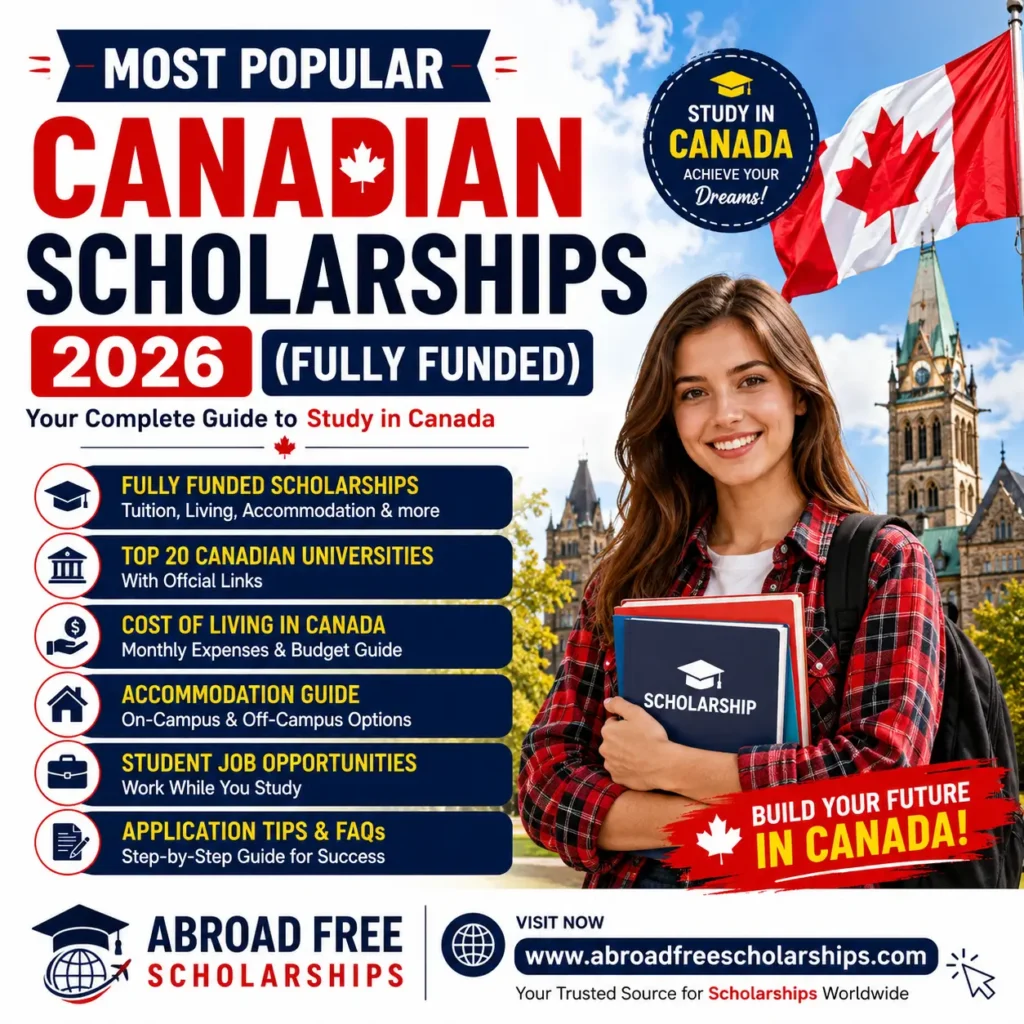
Most Popular Canadian Scholarships 2026 (Fully Funded): Complete Guide for International Students
Canada continues to rank among the world’s best study destinations, attracting hundreds of thousands of international students every year. Beyond its globally recognised universities, Canada offers generous scholarship opportunities that make higher education more affordable for talented students from around the world.
Whether you are planning to pursue a bachelor’s, master’s, or PhD degree, securing a scholarship can significantly reduce your financial burden. Some awards cover only tuition fees, while others are fully funded and include accommodation, books, health insurance, travel expenses, and monthly living allowances.
In this comprehensive guide, you’ll discover the Most Popular Canadian Scholarships 2026, their benefits, eligibility criteria, application requirements, and practical tips to improve your chances of receiving funding. You’ll also learn about leading scholarship providers, government-funded programs, and prestigious university scholarships available for international students.
If studying in Canada has always been your dream, this guide will help you take the first step with confidence.
Why Study in Canada in 2026?
Canada has become one of the most attractive destinations for international students for several reasons.
1. World-Class Universities
Canadian universities consistently appear among the world’s highest-ranked institutions. Universities such as the University of Toronto, McGill University, the University of British Columbia, the University of Waterloo, and McMaster University are internationally respected for research, innovation, and academic excellence.
2. Excellent Scholarship Opportunities
Every year, Canadian universities and government agencies invest millions of dollars in scholarships, fellowships, grants, and bursaries for international students. These funding opportunities reward academic excellence, leadership, research potential, and community involvement.
3. High Quality of Life
Canada offers a safe, multicultural, and welcoming environment. Students benefit from modern campuses, quality healthcare, reliable public transportation, and excellent support services.
4. Work While Studying
Eligible international students can work during their studies, helping them gain valuable Canadian work experience while earning additional income to support living expenses.
5. Post-Graduation Career Opportunities
Graduates from Canadian universities often qualify for post-graduation work opportunities, making Canada an attractive destination for students seeking international career experience.
Most Popular Canadian Scholarships 2026
Below are some of the most sought-after scholarships available for international students planning to study in Canada in 2026.
1. Lester B. Pearson International Scholarship
University: University of Toronto
Degree Level: Undergraduate
Scholarship Type: Fully Funded
Benefits
- Full tuition fees
- Books
- Incidental fees
- Full residence support
- Four years of funding
This is one of Canada’s most prestigious undergraduate scholarships for exceptional international students who demonstrate academic excellence, creativity, and leadership.
2. McCall MacBain Scholarships
University: McGill University
Degree Level: Master’s & Professional Programs
Coverage
- Full tuition
- Monthly living stipend
- Leadership development
- Mentorship
- Relocation support
The McCall MacBain Scholarship is highly competitive and focuses on future leaders who want to create positive change in society.
3. University of British Columbia International Scholars Program
University: University of British Columbia
Degree Level: Undergraduate
Benefits
- Full or partial tuition
- Living expenses
- Renewable funding
- Need-based financial support
UBC offers several prestigious awards for outstanding international students demonstrating academic excellence and leadership.
4. President’s International Entrance Scholarship
University: University of Calgary
Degree Level: Undergraduate
Benefits
- Significant tuition support
- Renewable scholarship
- Academic merit recognition
This scholarship rewards high-achieving international students entering undergraduate programs.
5. International Admission Scholarship
University: University of Alberta
Degree Level: Undergraduate
Benefits
- Merit-based funding
- Automatic consideration
- Multiple scholarship categories
The University of Alberta offers numerous entrance scholarships for academically outstanding international students.
6. President’s Scholarship for World Leaders
University: University of Winnipeg
Degree Level: Undergraduate & Graduate
Benefits
- Entrance scholarship
- Leadership recognition
- Financial assistance
7. International Leader of Tomorrow Award
University: University of British Columbia
Degree Level: Undergraduate
Benefits
- Tuition support
- Living expenses
- Renewable funding
8. York University Global Leader of Tomorrow Scholarship
University: York University
Degree Level: Undergraduate
Benefits
- Renewable financial support
- Merit-based selection
- Leadership recognition
9. Carleton Prestige Scholarships
University: Carleton University
Degree Level: Undergraduate
Benefits
- High-value entrance awards
- Renewable scholarships
- Academic excellence recognition
10. Humber International Entrance Scholarships
University: Humber Polytechnic
Degree Level: Undergraduate
Benefits
- Partial tuition waiver
- Merit-based awards
- Multiple intake opportunities
Scholarship Benefits
Although each scholarship has different funding conditions, many Canadian scholarships provide comprehensive financial support.
Typical benefits include:
- Full or partial tuition fees
- Monthly living allowance
- Free accommodation or residence support
- Health insurance
- Research funding
- Books and study materials
- Airfare assistance (selected scholarships)
- Conference and research travel funding
- Leadership and mentorship opportunities
Fully funded scholarships generally cover most major educational expenses, allowing students to focus on their academic goals instead of financial concerns.
General Eligibility Requirements
Each scholarship has its own eligibility criteria, but most require applicants to demonstrate strong academic performance and leadership potential.
Common requirements include:
Excellent Academic Record
Most competitive scholarships require consistently high grades or equivalent academic achievement.
English Language Proficiency
Applicants are generally expected to meet the language requirements of their chosen university through accepted English proficiency tests where applicable.
Leadership Experience
Participation in community service, volunteering, student organisations, sports, entrepreneurship, or leadership initiatives can strengthen an application.
Admission to a Canadian University
Many scholarships require applicants to first receive, or apply for, admission to an eligible Canadian university.
Supporting Documents
Applicants are commonly asked to submit:
- Academic transcripts
- Personal statement
- Motivation letter
- Curriculum Vitae (CV)
- Letters of recommendation
- Passport copy
- Language test results (if required)
Why These Scholarships Are Highly Competitive
Canada receives applications from talented students across the globe. Scholarship committees look beyond grades and seek applicants who can demonstrate:
- Academic excellence
- Leadership ability
- Community involvement
- Research potential
- Clear career goals
- Strong communication skills
- Commitment to creating positive social impact
Preparing a thoughtful application well in advance, supported by strong references and a compelling personal statement, can significantly improve your chances of success.
Top 20 Canadian Universities Offering Scholarships (2026)
The universities below are among Canada’s most recognised institutions for academic excellence, research, and international student scholarships. Before applying, always visit the official website to confirm admission requirements, scholarship opportunities, and application deadlines.
| # | University | Province | Official Website |
|---|---|---|---|
| 1 | University of Toronto | Ontario | https://www.utoronto.ca |
| 2 | University of British Columbia (UBC) | British Columbia | https://www.ubc.ca |
| 3 | McGill University | Quebec | https://www.mcgill.ca |
| 4 | University of Alberta | Alberta | https://www.ualberta.ca |
| 5 | McMaster University | Ontario | https://www.mcmaster.ca |
| 6 | University of Waterloo | Ontario | https://uwaterloo.ca |
| 7 | Western University | Ontario | https://www.uwo.ca |
| 8 | Queen’s University | Ontario | https://www.queensu.ca |
| 9 | University of Calgary | Alberta | https://www.ucalgary.ca |
| 10 | University of Ottawa | Ontario | https://www.uottawa.ca |
| 11 | Université de Montréal | Quebec | https://www.umontreal.ca |
| 12 | Simon Fraser University | British Columbia | https://www.sfu.ca |
| 13 | York University | Ontario | https://www.yorku.ca |
| 14 | Dalhousie University | Nova Scotia | https://www.dal.ca |
| 15 | University of Victoria | British Columbia | https://www.uvic.ca |
| 16 | University of Saskatchewan | Saskatchewan | https://www.usask.ca |
| 17 | Carleton University | Ontario | https://carleton.ca |
| 18 | Concordia University | Quebec | https://www.concordia.ca |
| 19 | Memorial University of Newfoundland | Newfoundland and Labrador | https://www.mun.ca |
| 20 | University of Guelph | Ontario | https://www.uoguelph.ca |
Tip: Most of these universities provide entrance scholarships, merit-based awards, graduate funding, and research assistantships for international students. Scholarship availability varies by faculty and degree level. Always apply early, as many scholarship deadlines fall before the general admission deadline.
Cost of Living in Canada for International Students (2026)
Besides tuition fees, students should prepare a realistic monthly budget for accommodation, food, transportation, and other daily expenses. Costs vary depending on the city, lifestyle, and type of housing.
Estimated Monthly Living Costs
| Expense | Estimated Cost (CAD/Month) |
|---|---|
| Accommodation | 700–1,800 |
| Food & Groceries | 250–500 |
| Transportation | 80–180 |
| Internet & Mobile | 60–120 |
| Health Insurance | 50–100 |
| Personal Expenses | 150–300 |
| Entertainment | 100–250 |
Average Monthly Budget
- Affordable cities: CAD 1,200–1,700
- Medium-cost cities: CAD 1,700–2,200
- Expensive cities (Toronto, Vancouver): CAD 2,200–3,000+
Living in smaller cities such as Saskatoon, Regina, Winnipeg, or Halifax is generally more affordable than living in Toronto or Vancouver. Budget carefully and take advantage of student discounts for transportation, software, and entertainment.
Student Accommodation in Canada
Accommodation is usually the largest non-tuition expense for international students. Choosing the right option depends on your budget, lifestyle, and preferred location.
1. On-Campus Residence
Many universities guarantee residence spaces for first-year students who apply before the housing deadline.
Advantages
- Close to classrooms and campus facilities
- Safe and secure environment
- Easy to meet other students
- Utilities often included
- Meal plans available at many universities
Typical Cost
- CAD 8,000–15,000 per academic year, depending on the university and room type.
2. Off-Campus Housing
Students who prefer greater independence often rent apartments, shared houses, or private rooms.
Common Options
- Shared apartment
- Private apartment
- Basement suite
- Student house
- Homestay with a Canadian family
Estimated Monthly Rent
| City | Shared Room | One-Bedroom Apartment |
|---|---|---|
| Toronto | CAD 900–1,400 | CAD 1,800–2,400 |
| Vancouver | CAD 950–1,400 | CAD 1,900–2,500 |
| Montreal | CAD 550–800 | CAD 1,000–1,500 |
| Ottawa | CAD 700–1,000 | CAD 1,400–1,900 |
| Calgary | CAD 650–950 | CAD 1,300–1,800 |
| Edmonton | CAD 550–850 | CAD 1,100–1,500 |
| Halifax | CAD 600–900 | CAD 1,200–1,600 |
How to Find Student Accommodation
Finding suitable housing is easier when you begin your search several months before your arrival.
Here are some reliable options:
University Housing Office
Most Canadian universities have dedicated housing offices that help students find both on-campus and off-campus accommodation.
University Residence Portals
After receiving your admission offer, you’ll usually gain access to the university’s residence application system.
Student Housing Platforms
Many universities recommend trusted accommodation partners and verified rental platforms for international students.
Facebook Student Groups
Many universities have official student housing groups where students advertise available rooms or look for roommates. Always verify listings and never transfer money before confirming the legitimacy of the accommodation.
Homestay Programs
Homestays allow students to live with Canadian families, offering cultural immersion and, in many cases, meals and utilities included.
Working While Studying in Canada
International students often work part-time to gain professional experience and help cover living expenses.
Eligible students can generally work up to 24 hours per week off campus during regular academic sessions and full-time during scheduled academic breaks, provided they meet the conditions of their study permit.
Popular Student Jobs
- Retail Sales Associate
- Customer Service Representative
- Barista
- Restaurant Server
- Library Assistant
- Research Assistant
- Teaching Assistant
- Campus Ambassador
- Tutor
- Administrative Assistant
- Delivery Driver (where eligible)
- Freelance Graphic Designer
- Social Media Assistant
Hourly wages vary by province, employer, and job type, but many student jobs pay around the applicable provincial minimum wage or higher.
Tips for Finding a Student Job
- Apply early after arriving in Canada.
- Visit your university’s Career Services Centre.
- Attend campus job fairs and networking events.
- Build a Canadian-style resume and cover letter.
- Create a professional LinkedIn profile.
- Explore on-campus employment opportunities.
- Develop transferable skills such as communication, teamwork, and digital literacy.
Balancing work with academics is important. Prioritise your studies and ensure any employment complies with the conditions of your study permit.
Budgeting Tips for International Students
Managing your finances wisely can make studying in Canada more affordable.
- Choose shared accommodation to reduce rent.
- Cook meals at home instead of eating out frequently.
- Use public transportation and student transit passes.
- Buy used textbooks or digital editions.
- Take advantage of student discounts offered by retailers and software providers.
- Track your monthly spending using a budgeting app or spreadsheet.
- Apply for scholarships, bursaries, and on-campus work opportunities whenever available.
Required Documents for Canadian Scholarships 2026
Preparing your documents well in advance can significantly improve your chances of receiving a scholarship. While every university and scholarship program has its own requirements, most applications request the following:
Academic Transcripts
Submit official transcripts from your previous school, college, or university. Strong academic performance remains one of the most important selection criteria.
Curriculum Vitae (CV) or Resume
Your CV should highlight:
- Educational background
- Research experience (if applicable)
- Leadership roles
- Volunteer work
- Awards and achievements
- Internships
- Relevant work experience
Keep your CV clear, concise, and tailored to the scholarship.
Personal Statement or Statement of Purpose (SOP)
A strong SOP explains:
- Why you want to study in Canada
- Why you selected your program
- Your academic and career goals
- How the scholarship will help you achieve those goals
- Your leadership experience and community involvement
Avoid generic statements. Use real examples to demonstrate your motivation and achievements.
Letters of Recommendation
Most scholarship providers ask for two or three recommendation letters from:
- Teachers
- Professors
- Academic supervisors
- Employers (if relevant)
Choose referees who know your academic abilities and can provide detailed, personalised recommendations.
English Language Proficiency
Depending on the university and your previous education, you may need to submit:
- IELTS
- TOEFL
- PTE Academic
- Duolingo English Test (accepted by many universities)
Always check the language requirements of your chosen institution before applying.
Passport
A valid passport is required for admission and future study permit applications.
How to Apply for Canadian Scholarships
Applying for scholarships can seem overwhelming, but following a structured approach makes the process much easier.
Step 1: Research Scholarships
Identify scholarships that match your:
- Degree level
- Academic background
- Nationality
- Field of study
- Financial need (if applicable)
Always verify eligibility requirements on the official university or scholarship website.
Step 2: Choose Your University
Select Canadian universities offering programs that align with your academic interests and career goals.
Review scholarship deadlines carefully, as they often differ from admission deadlines.
Step 3: Apply for Admission
Many university scholarships automatically consider applicants after they submit an admission application, while others require a separate scholarship application.
Read the instructions carefully to avoid missing additional forms or supporting documents.
Step 4: Prepare a Strong Scholarship Application
Focus on quality rather than quantity.
Your application should clearly demonstrate:
- Academic excellence
- Leadership potential
- Community engagement
- Career aspirations
- Research interests (for graduate applicants)
A compelling personal statement often makes the difference between successful and unsuccessful applications.
Step 5: Submit Before the Deadline
Late applications are generally not accepted.
Create a checklist and submit all required documents well before the deadline to avoid technical issues.
Common Mistakes to Avoid
Many qualified students miss scholarship opportunities because of avoidable errors.
Avoid these common mistakes:
Waiting Until the Last Minute
Start preparing several months before the application deadline.
Using the Same Personal Statement Everywhere
Customize each application to match the scholarship’s objectives and selection criteria.
Ignoring Eligibility Requirements
Before applying, ensure you meet every eligibility requirement.
Weak Recommendation Letters
Choose referees who know your work well and can write detailed, meaningful recommendations.
Incomplete Applications
Double-check every section before submitting.
Missing documents can result in automatic disqualification.
Focusing Only on Fully Funded Scholarships
While fully funded scholarships are highly competitive, many partially funded scholarships can still reduce your education costs significantly.
Tips to Improve Your Scholarship Chances
Competition for Canadian scholarships is strong, but thoughtful preparation can make your application stand out.
Here are some practical strategies:
- Maintain excellent academic performance.
- Participate in volunteer and community service activities.
- Take on leadership roles in school or university.
- Build a strong portfolio of extracurricular achievements.
- Gain research experience if you are applying for graduate studies.
- Write a personalised Statement of Purpose for each application.
- Apply for multiple scholarships rather than relying on just one.
- Ask mentors or professors to review your application before submission.
Consistency and preparation often matter just as much as grades.
Frequently Asked Questions (FAQs)
Can international students get fully funded scholarships in Canada?
Yes. Several Canadian universities and scholarship programs offer fully funded opportunities for outstanding international students. These scholarships may cover tuition fees, accommodation, books, and living expenses. However, eligibility requirements and funding levels vary by program.
When should I apply for Canadian scholarships for 2026?
Most applications open between September and January, depending on the university and scholarship. It is recommended to begin researching opportunities at least six to twelve months before your intended intake.
Do I need IELTS to receive a Canadian scholarship?
Not always. Some universities waive English language tests if you previously studied in English or meet alternative language requirements. Always review the admission policy of your chosen university before applying.
Are Canadian scholarships available for undergraduate, master’s, and PhD students?
Yes. Canada offers scholarships at every study level, including bachelor’s, master’s, doctoral, and postdoctoral programs. Funding options vary depending on the institution and scholarship provider.
Can I work while studying in Canada?
Yes. Eligible international students can work while studying if they meet the conditions of their study permit. As of 2026, eligible students may generally work up to 24 hours per week off campus during regular academic sessions and unlimited hours during scheduled breaks. On-campus work is permitted for eligible students without a set hourly limit. Always check the latest IRCC rules before accepting employment, as immigration policies can change.
Conclusion
Canada continues to be one of the world’s leading destinations for international education, offering globally recognised universities, high-quality academic programs, and a wide range of scholarship opportunities.
Whether you are applying for an undergraduate, master’s, or doctoral degree, careful planning, strong academic performance, and a well-prepared scholarship application can greatly improve your chances of success.
Start researching scholarships early, prepare your documents well in advance, and submit complete applications before the deadlines. Even if you do not secure a fully funded award, many partial scholarships and bursaries can significantly reduce the cost of studying in Canada.
With the right preparation, your dream of earning a Canadian degree can become a reality.
Call to Action
Ready to begin your study abroad journey?
Explore the latest Canadian Scholarships 2026, compare university funding opportunities, and bookmark this guide for future reference. If you found this article helpful, share it with friends and classmates who are also planning to study in Canada, and continue exploring more fully funded scholarship opportunities on Abroad Free Scholarships.