
If you’ve been scrolling through scholarship boards looking for a research opportunity that actually pays your way through a doctorate, this one deserves your attention. The Fully Funded PhD Positions in HUGO Lab at the University of South Carolina are now open, and they’re aimed at students who want to study how humans interact with machines, robots, and AI systems in the real world — not just in theory.
This article walks you through everything: what the lab studies, who qualifies, what financial support looks like, where you’ll live in Columbia, how to put together your application, and what to expect if you’re invited to interview. By the end, you’ll know exactly whether this opportunity fits your goals and what your next move should be.
What Is the HUGO Lab and Why It Matters
HUGO stands for HUman Factors and erGOnomics, and the lab sits inside the Department of Mechanical Engineering at the University of South Carolina. Its researchers study something that touches nearly every industry: how people actually behave when they work alongside machines, robots, vehicles, and increasingly, artificial intelligence systems.
Think about a factory floor where a robotic arm works next to a human technician, a control room where operators monitor a pipeline for hours at a stretch, or a car that partially drives itself while a person still needs to stay alert. In every one of these situations, small design choices about how information is displayed, how alerts are triggered, or how a machine signals its next move can mean the difference between a smooth workday and a costly accident. That’s the exact problem space HUGO Lab tackles.
The lab’s work spans human-AI interaction, human-machine and human-robot interaction, industrial safety, vehicle ergonomics, digital twin systems, and human-centered product design. Its findings feed directly into transportation systems, energy infrastructure, industrial operations, and pipeline safety programs — meaning your PhD research wouldn’t sit in a drawer somewhere. It would inform decisions that affect real workplaces and real people.
For anyone coming from a background in mechanical engineering, industrial engineering, robotics, human factors, or applied psychology, this lab offers a rare mix: rigorous experimental research with a clear, practical payoff. That combination is exactly what makes these Fully Funded Scholarships worth a serious look.
Course and Scholarship Benefits: What You Actually Get
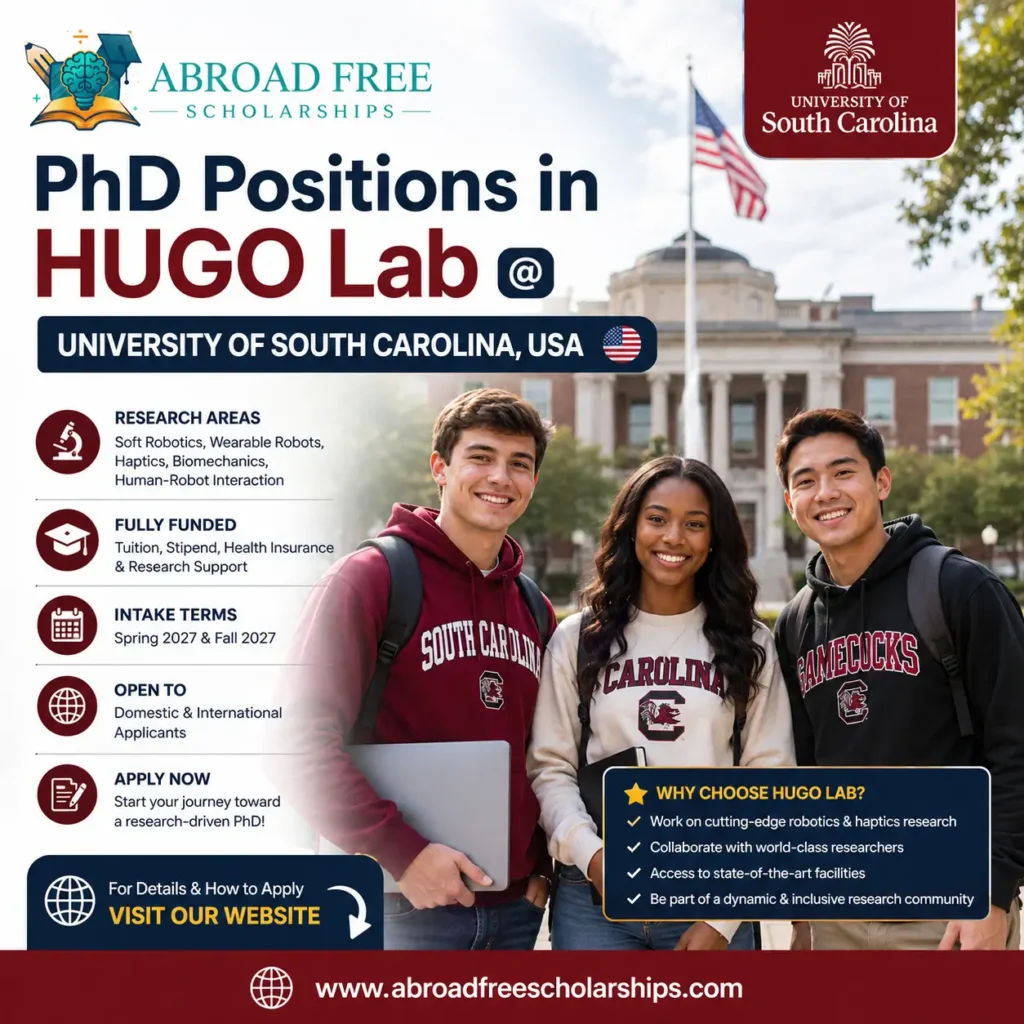
Funding is often the single biggest obstacle standing between a talented student and a PhD, so let’s break down exactly what’s on the table. Selected candidates receive a package designed to remove financial stress from the equation entirely, letting them focus on research instead of tuition bills.
Here’s what the funding includes:
- Full tuition waiver — no out-of-pocket tuition costs for the duration of guaranteed funding.
- Monthly living stipend — a recurring income to cover rent, food, and daily expenses.
- Guaranteed funding for the first two years — removing the year-to-year funding anxiety that many PhD students face early on.
- Continued funding beyond year two, contingent on satisfactory academic progress and research performance.
Beyond the money, there’s the academic value of working under close faculty mentorship in a lab that’s actively publishing in human factors and ergonomics research. PhD students typically get hands-on experience designing experiments, running user studies, analyzing data with statistical tools, and co-authoring papers — all of which build a strong foundation for careers in academia, industry R&D, or government research labs.
It’s worth comparing this to programs where funding is only guaranteed semester-by-semester, or where students are expected to secure their own external grants. A two-year guarantee, with a clear path to continued support, is a meaningfully stronger safety net than many peer programs offer. That’s a major reason this listing is generating buzz among prospective applicants searching for Fully Funded Scholarships in engineering and human factors fields.
Eligibility Criteria and Who Should Apply
Before you spend hours drafting a cover letter, it’s worth checking whether you actually meet the baseline requirements. The HUGO Lab is looking for candidates who bring both academic credentials and a genuine interest in human-centered systems.
Minimum Academic Requirements
Applicants should hold a master’s degree in engineering or a closely related field. The lab is flexible about the exact discipline — mechanical engineering, industrial engineering, human factors, robotics, and related backgrounds are all welcome — but the underlying expectation is a demonstrated foundation in technical or applied research.
On top of the degree itself, the university’s graduate admissions office sets its own thresholds:
- Minimum undergraduate GPA of 3.0 out of 4.0
- GRE scores of at least 150 (Verbal) and 155 (Quantitative)
- For international applicants: TOEFL iBT of 80 or higher, or IELTS of 6.5 or higher
Preferred (Not Mandatory) Qualifications
A few extras won’t disqualify you if you’re missing them, but they will strengthen your application considerably:
- Published research, whether in journals or conference proceedings
- Programming experience, with MATLAB specifically mentioned as a plus
- Familiarity with statistical methods such as regression analysis and ANOVA
- Prior experience running experiments or working with data sets
If you’re a strong technical candidate but haven’t published yet, don’t be discouraged — the lab explicitly frames publications as preferred, not required. What matters most is a genuine, well-articulated interest in the research areas the lab covers, backed by relevant coursework or project experience.
Living in Columbia, South Carolina: Accommodation and Cost of Living
One detail that often gets overlooked in scholarship research is where you’ll actually be living for the next four to six years. Columbia, South Carolina is the state capital and home to the university’s main campus, and it’s a notably affordable option compared to major coastal cities.
On-Campus and Near-Campus Housing
Graduate students typically have a few housing routes to choose from. University-affiliated graduate housing offers convenience and a built-in community of fellow researchers, which can be especially helpful in your first year while you’re still getting oriented. Off-campus apartments near the university are widely available and tend to be significantly cheaper than housing in cities like Boston, San Francisco, or New York, stretching your monthly stipend considerably further.
What to Expect Cost-Wise
Columbia’s cost of living sits well below the national average in categories like rent, groceries, and transportation. Many graduate students find that a monthly stipend from a funded PhD position covers essentials comfortably, particularly if they share housing with roommates or opt for accommodation slightly outside the immediate downtown area.
It’s also a college town with a functioning public transit system, a walkable downtown near the Congaree River, and a reasonably mild climate for most of the year, which makes day-to-day logistics easier for international students adjusting to a new country.
(Internal linking opportunity: link this section to a dedicated guide on “Cost of Living for International Students in the USA” if one exists on your site.)
Step-by-Step Guide: How to Apply for This Scholarship
Applying for a funded PhD position is different from a standard graduate school application — it’s more targeted, and it often starts with direct contact with the lab before you even touch the university’s formal application portal. Here’s how to approach it methodically.
Step 1: Confirm Your Eligibility
Before drafting anything, check your GPA, GRE scores, and English proficiency scores (if applicable) against the minimums listed above. This saves you time and helps you decide if you need to strengthen any component before applying.
Step 2: Prepare Your Application Documents
Gather the following materials, all of which should be polished and tailored specifically to this position:
- A one-page cover letter explaining your interest in the lab’s research
- An updated Curriculum Vitae (CV)
- A one-page statement of research interests, connecting your background to HUGO Lab’s focus areas
- Official academic transcripts
- Three letters of recommendation
- A personal statement
Step 3: Contact the Lab Directly
Unlike many programs where you apply cold through a portal, this opportunity asks candidates to email their documents directly to the lab’s incoming faculty contact. This is your chance to make a strong first impression, so keep your email concise, professional, and specific about why you’re a fit for this particular lab rather than a generic “I’m interested in your program” message.
Step 4: Meet the Deadlines
Deadlines differ depending on which intake you’re targeting and whether you’re a domestic or international applicant:
Spring 2027 intake
- International applicants: October 1, 2026
- Domestic applicants: October 15, 2026
Fall 2027 intake
- International applicants: May 1, 2027
- Domestic applicants: May 15, 2027
International applicants generally face earlier deadlines because of visa processing timelines, so don’t wait until the last week to submit.
Step 5: Wait for Shortlisting and Interview Invitations
Only shortlisted candidates move forward to an interview stage, so make sure every document you submit is proofread and consistent in tone and formatting.
A Complete Breakdown of the Interview Process
Once your application clears the initial screening, you’ll be invited to an interview, conducted either online or in person depending on your location and the lab’s scheduling. While the exact format can vary by cycle, most funded research-lab interviews at this stage — sometimes referred to informally as a multi-component review process — follow a fairly predictable structure that candidates can prepare for.
What the Interview Typically Covers
Expect the conversation to move through a few core areas: your research background and technical skills, your understanding of human factors and ergonomics as a field, and your specific interest in the lab’s current projects. Faculty will likely probe how you’ve handled data analysis or experimental design in the past, since that experience translates directly into the kind of work you’d be doing as a PhD student.
You should also expect questions about your long-term goals. Labs investing years of funding into a student want confidence that your research interests align with theirs beyond just the first semester.
How to Prepare
- Re-read the lab’s published research areas and be ready to discuss which ones genuinely excite you and why
- Review your own CV closely — be ready to explain any project, tool, or method listed on it in detail
- Prepare a few thoughtful questions about lab culture, current projects, and expectations for first-year students
- If you have publications, be ready to summarize your contribution clearly and concisely
- Practice explaining technical concepts in plain language, since interviewers may include people from adjacent disciplines
After the Interview
Following the interview, decisions are typically communicated within a few weeks. If selected, you’ll receive formal next steps regarding the university’s graduate admission process, funding confirmation, and enrollment paperwork.
Frequently Asked Questions
Is the HUGO Lab PhD position really fully funded? Yes. Selected students receive a full tuition waiver and a monthly stipend, with guaranteed funding for the first two years and continued support afterward based on academic and research performance.
Who can apply for these PhD positions? Applicants from all nationalities are eligible. You’ll need a master’s degree in engineering or a related field, along with GPA, GRE, and English proficiency scores that meet the university’s graduate admission standards.
What is the application deadline? Deadlines depend on your intended intake and applicant status. For Spring 2027, international applicants must apply by October 1, 2026, and domestic applicants by October 15, 2026. For Fall 2027, the deadlines are May 1 and May 15, 2027, respectively.
Do I need a GRE score to apply? Yes, the university’s graduate admission requirements include a minimum GRE score of 150 (Verbal) and 155 (Quantitative).
Is prior research publication required? No, publications are listed as a preferred qualification, not a mandatory one. A strong academic record and a clear statement of research interest can still make you a competitive candidate.
Final Thoughts and Your Next Step
Fully funded PhD positions that combine real financial security with meaningful, applied research don’t come around often. The HUGO Lab’s focus on human-AI and human-robot interaction places it at the center of one of engineering’s fastest-growing research areas, and the funding package removes the financial guesswork that derails so many promising applications.
If your background touches engineering, human factors, robotics, or ergonomics, and you’re ready to commit to a research program that actually shapes how humans and machines work together, this is worth your time to apply. Start by checking your eligibility against the criteria above, gather your documents early, and reach out to the lab directly well before the deadline — strong applications rarely come together at the last minute.
Ready to take the next step? Review the full eligibility checklist, prepare your CV and statement of research interests today, and get your application in ahead of the October or May deadline that applies to you.
(Internal linking opportunity: link to your site’s broader “Fully Funded PhD Scholarships” category page and any related “How to Write a Statement of Research Interest” guide.)
How to Apply
Interested candidates must complete both of the following steps:
- Email your application documents to the Principal Investigator:Dr. Jangwoon Park
Email:
parkj@sc.edu - Submit your official PhD application through the
University of South Carolina Graduate Application Portal.
Application Documents
- One-page Cover Letter
- Curriculum Vitae (CV)
- One-page Statement of Research Interests
- Official Academic Transcripts
- Three Letters of Recommendation
- Personal Statement
Official Links
- Apply to the University of South Carolina Graduate School
- Mechanical Engineering PhD Program Requirements
Application Deadlines
| Admission Term | International Applicants | Domestic Applicants |
|---|---|---|
| Spring 2027 | October 1, 2026 | October 15, 2026 |
| Fall 2027 | May 1, 2027 | May 15, 2027 |