
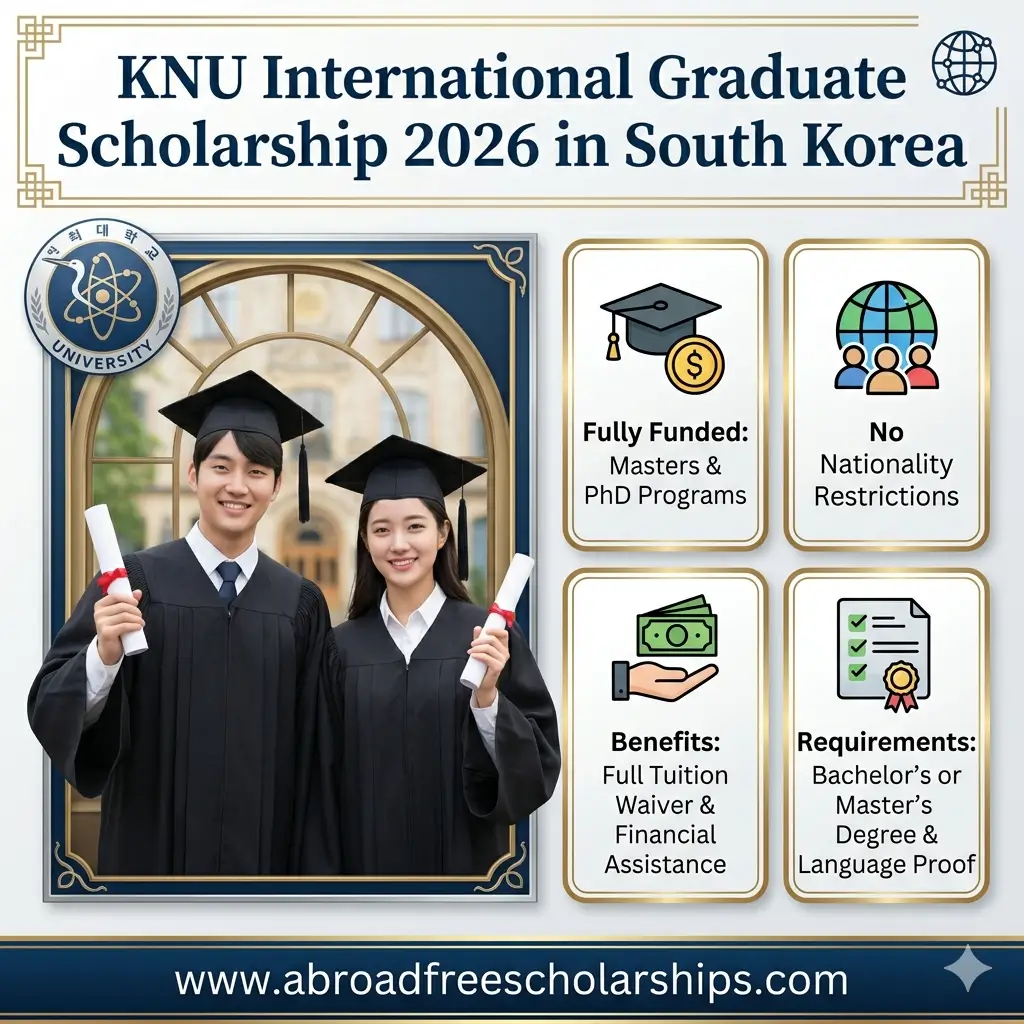
KNU International Graduate Scholarship 2026 in South Korea
Applications are now open for the KNU International Graduate Scholarship 2026 in South Korea. This prestigious scholarship is offered by Kyungpook National University (KNU) for international students who want to pursue Master’s or Doctoral degree programs in Korea. The scholarship provides generous financial support including tuition fee waivers and academic funding for outstanding students from around the world.
Kyungpook National University is one of the leading universities in South Korea located in Daegu. Every year the university welcomes talented international students to study graduate programs across multiple disciplines including engineering, business, sciences, humanities, and technology.
This scholarship is an excellent opportunity for students seeking high-quality education in Korea with financial support.
Scholarship Summary
- Host Country: South Korea
- University: Kyungpook National University
- Degree Level: Masters / PhD
- Scholarship Type: Funded
- Eligible Nationalities: International Students
- Application Deadline: 31 October 2025
The program aims to attract talented international students and support them in completing graduate studies at KNU.
Financial Benefits
The KNU International Graduate Scholarship 2026 provides financial assistance to international students including:
- Full tuition fee waiver (100%)
- Partial tuition waiver (50%) depending on department ranking
- Scholarship opportunities renewed each semester
- Possible research support and academic funding
- Access to university facilities and research laboratories
Available Study Programs
Students can apply for graduate programs in fields such as:
- Engineering and Technology
- Natural Sciences
- Business Administration
- Social Sciences
- Humanities
- International Studies
The scholarship supports Master’s, Doctoral, and Integrated Graduate Programs offered by Kyungpook National University.
Eligibility Criteria
To apply for the KNU Graduate Scholarship, applicants must meet the following requirements:
- Must be an international student (non-Korean nationality)
- Must hold a Bachelor’s degree for Master’s programs
- Must hold a Master’s degree for PhD programs
- Must meet English or Korean language requirements
- Must receive admission to a graduate program at KNU
Original Step-by-Step Application Guide Based on Real Applicant Experiences
Many successful international applicants recommend starting preparations at least 3–4 months before the application deadline. Since the KNU International Graduate Scholarship automatically considers eligible admitted students for funding, the primary focus should be submitting a strong admission application.
- Step 1: Review your preferred graduate department and research area at Kyungpook National University (KNU).
- Step 2: Contact potential supervisors if your department encourages faculty communication before admission.
- Step 3: Prepare academic transcripts, degree certificates, passport copy, recommendation letters, and language proficiency documents.
- Step 4: Draft a customized Statement of Purpose and Study Plan that aligns with KNU’s academic strengths.
- Step 5: Carefully complete the online application form and double-check all personal information.
- Step 6: Upload all required documents in the correct format and size.
- Step 7: Submit your application several days before the deadline to avoid technical issues.
- Step 8: Monitor your email regularly for document verification requests or interview invitations.
- Step 9: After admission approval, follow visa and enrollment instructions provided by KNU.
- Step 10: Complete dormitory and accommodation applications immediately after receiving your admission letter.
Applicants who begin document preparation early often experience a smoother application process and have more time to improve their motivation letters and recommendation documents.
Common Mistakes to Avoid When Applying for This Scholarship
Even highly qualified applicants can face rejection because of avoidable errors. Consider the following common mistakes before submitting your application:
- Submitting incomplete academic transcripts or missing pages.
- Using a generic Statement of Purpose that is not tailored to KNU.
- Ignoring department-specific admission requirements.
- Uploading blurry or improperly scanned documents.
- Waiting until the final day to submit the application.
- Providing inconsistent information across documents.
- Using recommendation letters that do not highlight academic or research strengths.
- Failing to demonstrate clear research goals for Master’s or PhD studies.
- Not proofreading the application for grammar and formatting errors.
- Missing important emails from the university due to inactive email monitoring.
A well-organized application package often creates a stronger impression than one submitted in haste, even when academic qualifications are similar.
Tips for Writing the Motivation Letter for the KNU International Graduate Scholarship
The motivation letter is one of the most influential parts of your application. Admissions committees use it to assess your academic goals, research interests, and suitability for graduate study.
Recommended Structure
- Introduction: Briefly introduce your academic background and career aspirations.
- Academic Journey: Explain key achievements, projects, internships, or research experiences.
- Why KNU: Mention specific departments, laboratories, faculty interests, or research facilities that attracted you to the university.
- Research Goals: Describe the problem you want to study and how the program supports your objectives.
- Future Impact: Explain how the degree will contribute to your career and home country.
- Conclusion: Reinforce your commitment to academic excellence and international collaboration.
Additional Tips
- Keep the content specific to KNU rather than using a generic scholarship essay.
- Use measurable achievements whenever possible.
- Demonstrate research readiness and academic curiosity.
- Avoid excessive personal storytelling unrelated to academics.
- Maintain a professional and confident tone throughout the letter.
- Proofread multiple times before submission.
How to Get an Accommodation Voucher as an International Student
Although accommodation support policies can vary by semester and department, international students can improve their chances of securing housing assistance and discounted accommodation by following these steps:
- Apply for university dormitories immediately after receiving admission confirmation.
- Regularly check the university’s international student office announcements.
- Participate in orientation programs where housing assistance opportunities are often announced.
- Contact the dormitory administration regarding available discounts or housing support programs.
- Join international student communities that share housing opportunities and promotional accommodation offers.
- Ask your department coordinator whether special accommodation grants are available for international researchers.
- Maintain full-time enrollment status, as some housing benefits require active student registration.
Students who apply early generally have access to a wider range of dormitory options and housing support opportunities compared to late applicants.
A Complete Breakdown of the MTCP Interview Process
For applicants who may also be preparing for competitive international scholarship interviews, understanding the MTCP-style interview structure can help improve confidence and performance.
Stage 1: Introduction and Background Assessment
- Personal introduction.
- Educational background discussion.
- Current professional or academic activities.
- Leadership and extracurricular involvement.
Stage 2: Academic and Program Motivation
- Reasons for selecting the program.
- Reasons for choosing the host country and university.
- Understanding of the academic field.
- Long-term educational objectives.
Stage 3: Career Vision and Future Contribution
- Career development plans after graduation.
- Expected contribution to home-country development.
- Industry or research impact goals.
- Knowledge transfer strategies.
Stage 4: Technical and Subject-Specific Questions
- Questions related to your academic specialization.
- Research methodology discussions.
- Problem-solving scenarios.
- Current developments within your field.
Stage 5: Final Evaluation
- Communication skills assessment.
- Confidence and professionalism.
- Leadership potential.
- Commitment to completing the program successfully.
Interview Preparation Tips
- Practice a concise self-introduction.
- Research your academic field thoroughly.
- Prepare examples demonstrating leadership and initiative.
- Review your motivation letter before the interview.
- Use specific examples when answering questions.
- Maintain professional attire and a positive attitude.
Required Documents
Applicants typically need to prepare the following documents:
- Completed application form
- Statement of purpose or study plan
- Recommendation letter
- Academic transcripts
- Degree certificates
- Language proficiency certificate
- Passport copy
- Birth certificate or family register
Some programs may also require a portfolio for design or art programs.
How to Apply for the KNU International Graduate Scholarship
The application process is simple. Candidates do not need to submit a separate scholarship application.
- Apply for admission to a graduate program at Kyungpook National University.
- Submit all required documents through the online application system.
- Departments review applicants and recommend qualified students.
- Selected students automatically receive the KNU International Graduate Scholarship.
Why Study at Kyungpook National University?
Kyungpook National University is one of Korea’s top public research universities known for its strong academic programs and global research environment. Students benefit from:
- International research opportunities
- Modern laboratories and facilities
- Diverse student community
- Affordable education in South Korea
- Career opportunities in Asia’s growing economy
Studying at KNU allows international students to gain global exposure while studying in one of Asia’s most advanced countries.