
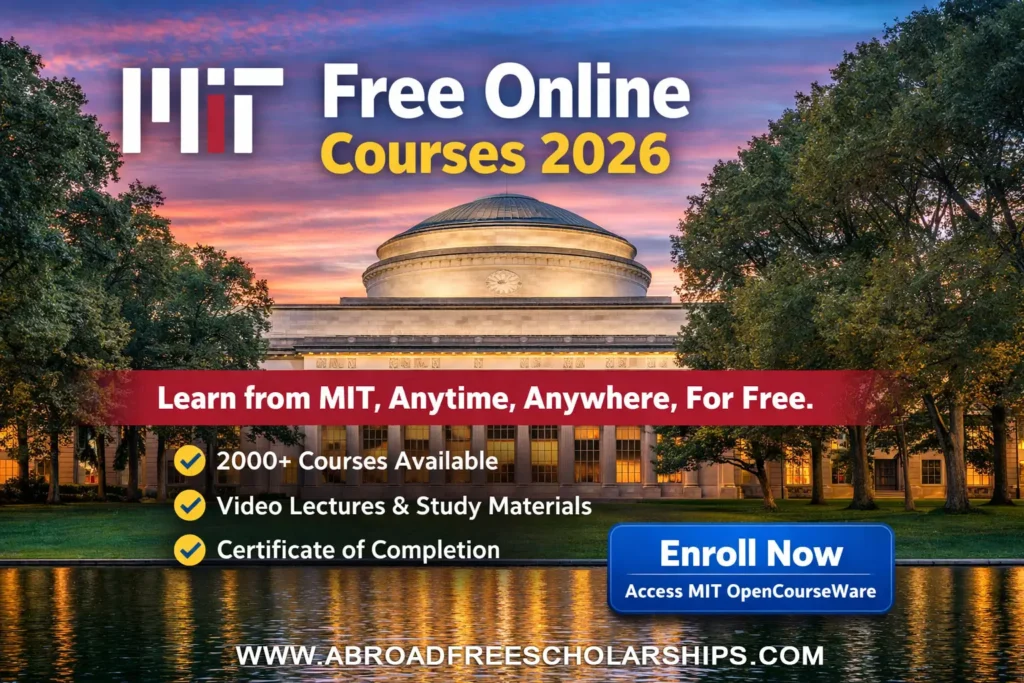
MIT Free Online Courses 2026 – Learn From the World’s Top University
The Massachusetts Institute of Technology (MIT) offers an extensive range of free online courses in 2026 through its award-winning OpenCourseWare (OCW) platform and MITx programs. These courses allow learners globally to access high-quality academic materials, lecture notes, videos, and assignments without cost. Whether you want to learn data science, engineering, humanities, mathematics, or business, MIT’s online resources make advanced learning accessible to everyone. :contentReference[oaicite:1]{index=1}
📘 What Are MIT Free Online Courses?
MIT OpenCourseWare (OCW) is an open-access digital library of teaching materials from over 2,500 MIT courses across the institute’s curriculum. OCW content includes lecture notes, reading lists, assignments, exams, and sometimes video lectures — all freely available to learners worldwide.
In addition to OCW, MITx — offered through platforms like edX — provides structured online courses where learners can audit for free and optionally pay a small fee to earn a verified certificate.
🎓 Why Choose MIT’s Free Online Courses?
- 100% Free Access: No tuition, no application fees, and in most cases no account is required to view OCW materials.
- Self-Paced Learning: Study at your own pace without deadlines or schedule constraints.
- World-Class Content: Learn from the same course materials used in MIT’s campus programs.
- Wide Variety of Subjects: Covers STEM, business, design, humanities, economics, languages, and more.
- Optional Certificates: Certificates available through MITx for a fee, which can enhance resumes and portfolios.
🗂 Available Course Categories
Below are some major areas where MIT offers free online learning materials:
- Aeronautics & Astronautics
- Architecture
- Biology & Biological Engineering
- Chemistry & Chemical Engineering
- Computer Science & Electrical Engineering
- Economics, Management & Business Analytics
- Mathematics & Statistics
- Physics & Materials Science
- Urban Studies & Planning
- Humanities, History & Linguistics
These areas contain hundreds of individual courses spanning introductory to advanced topics.
📌 How to Access MIT Free Online Courses
- Visit the official MIT OpenCourseWare website to browse course materials.
- Search by subject, department, or keyword to find a course you’re interested in.
- Click the course to view lecture notes, videos, assignments, and other materials.
- If you want a certificate, visit the MITx catalog, audit the course for free, and optionally upgrade for a verified certificate.
📈 Benefits of Learning With MIT Online Courses
Whether you are a student, professional, lifelong learner, or educator:
- ✔ Gain knowledge from one of the world’s most prestigious universities.
- ✔ Build new skills relevant to today’s job market.
- ✔ Improve problem-solving and critical thinking abilities.
- ✔ Study from anywhere — all you need is an internet connection.
Original Step-by-Step Application Guide Based on Real Learning Experiences
Although MIT OpenCourseWare (OCW) and MITx free courses do not require a formal admission application, successful learners often follow a structured approach to maximize the benefits of these world-class learning opportunities.
- Visit the official MIT OpenCourseWare or MITx platform and explore available subjects.
- Select a course that aligns with your academic goals, career interests, or future scholarship plans.
- Review the course syllabus, prerequisites, recommended textbooks, and learning outcomes.
- Create a realistic study schedule and dedicate specific hours each week for learning.
- Download lecture notes, assignments, and supplementary resources for offline study.
- Complete quizzes, projects, coding exercises, or assignments where available.
- Maintain a learning portfolio documenting completed coursework and acquired skills.
- Add completed MIT learning experiences to your CV, LinkedIn profile, or scholarship applications.
- Use newly acquired knowledge to strengthen future university admissions and scholarship applications.
- Continue progressing toward advanced MITx certificate programs if certification is required.
Many successful international students report that documenting their learning journey and applying acquired skills in practical projects significantly improved their university and scholarship applications.
Common Mistakes to Avoid When Applying for Scholarships
Many students use MIT online courses to strengthen future scholarship applications. Avoid these common mistakes when preparing scholarship submissions:
- Submitting generic personal statements for multiple scholarship programs.
- Failing to demonstrate how completed MIT courses relate to academic goals.
- Ignoring scholarship eligibility requirements and deadlines.
- Providing incomplete academic documents.
- Not highlighting practical projects completed during online learning.
- Using copied or AI-generated motivation letters without personalization.
- Failing to explain long-term career objectives.
- Neglecting extracurricular achievements and leadership experience.
- Submitting applications without proofreading.
- Waiting until the final day to submit important documents.
Scholarship reviewers generally favor applicants who clearly connect their learning experiences with future academic and professional objectives.
Tips for Writing the Motivation Letter for This Program
While MIT OpenCourseWare itself does not require a motivation letter, many students use MIT courses to support scholarship, internship, exchange, and university applications. The following strategies can help create a stronger motivation letter:
- Start with a clear explanation of your academic interests and career aspirations.
- Describe specific MIT courses that influenced your educational development.
- Explain how the knowledge gained supports your future study plans.
- Provide examples of projects, research, or independent learning activities completed.
- Demonstrate commitment to continuous learning and professional growth.
- Show measurable outcomes achieved through online learning.
- Connect your goals with the objectives of the scholarship or academic program.
- Maintain a professional, authentic, and evidence-based writing style.
- Avoid exaggeration and unsupported claims.
- Conclude with a clear statement about your future contributions to society or your field.
Strong motivation letters focus on personal growth, academic preparation, and clearly defined future objectives.
How to Get an Accommodation Voucher as an International Student
MIT OpenCourseWare participants study online and therefore do not require accommodation. However, students who later secure admission, internships, scholarships, or exchange opportunities abroad may benefit from accommodation support programs.
- Check whether your scholarship includes housing support or living allowances.
- Contact the university’s international student office regarding accommodation assistance.
- Apply early for university residence halls and student housing.
- Monitor scholarship announcements for housing grants and accommodation vouchers.
- Join international student groups that share housing opportunities.
- Request official accommodation guidance after receiving an admission offer.
- Compare university-managed housing with private accommodation options.
- Keep copies of housing-related documents for visa applications.
- Review local transportation access before selecting accommodation.
- Confirm all accommodation arrangements through official university channels.
Students should always verify accommodation benefits directly with the scholarship provider or host institution before making travel arrangements.
A Complete Breakdown of the MTCP Interview Process
The Malaysia Technical Cooperation Programme (MTCP) interview process is not related to MIT OpenCourseWare. However, many international students use free MIT courses to strengthen their academic profiles before applying for competitive scholarships such as MTCP.
Typical MTCP Interview Stages
- Application Screening: Academic qualifications and eligibility requirements are reviewed.
- Document Verification: Supporting documents are checked for authenticity and completeness.
- Interview Invitation: Shortlisted candidates receive interview notifications.
- Academic Assessment: Interviewers evaluate educational background and subject knowledge.
- Motivation Evaluation: Candidates explain their reasons for pursuing the scholarship.
- Leadership Assessment: Personal achievements, volunteer work, and leadership potential are discussed.
- Future Contribution Questions: Applicants explain how they will use acquired knowledge after graduation.
- Communication Assessment: Clarity, confidence, and professionalism are evaluated.
- Final Ranking: Candidates are assessed against scholarship objectives.
- Selection Decision: Successful candidates receive official scholarship offers.
MTCP Interview Preparation Tips
- Review your academic background thoroughly.
- Prepare examples demonstrating leadership and initiative.
- Practice answering questions about long-term career goals.
- Be ready to discuss any online courses, certifications, or research experience.
- Provide clear and concise responses supported by real achievements.
- Demonstrate how the scholarship aligns with national development and community impact goals.
📝 Frequently Asked Questions (FAQs)
Are the courses really free?
Yes. Most materials on MIT OpenCourseWare are completely free. Some structured courses on MITx allow certification for a fee.
Do I need to apply?
No formal application is required for OCW courses. You can start learning immediately.
Can I get a certificate?
Certificates are not available through OCW. However, MITx courses can provide a verified certificate for a fee if the course offers it.
🚀 Start Learning Today
MIT’s free online courses provide a world-class education without financial barriers. Whether your goal is career advancement, academic enrichment, or personal growth, these courses make it possible for anyone — everywhere — to learn from MIT. Explore the vast catalog and start learning today!