
Scholarship Essay Mistakes That Get You Rejected (with Real Analytical Examples)
Let’s Start Here: Your Draft Isn’t the Problem, Your Hiding Is
You’ve found the personal statement prompt, you’ve opened a blank document, and suddenly every thought feels either too braggy or too boring. Take a breath. After a decade of reading scholarship essays for competitive global programs, I can promise you this: most rejections aren’t about weak grades or missing awards. They happen because a perfectly strong applicant accidentally writes an essay that hides who they really are.
The three mistakes below are the ones I’ve seen sink countless applications. They’re not character flaws. They’re natural, fear-driven writing traps. And once you know how to spot them, they’re completely fixable. Let’s walk through each one together, with real examples you can steal from.
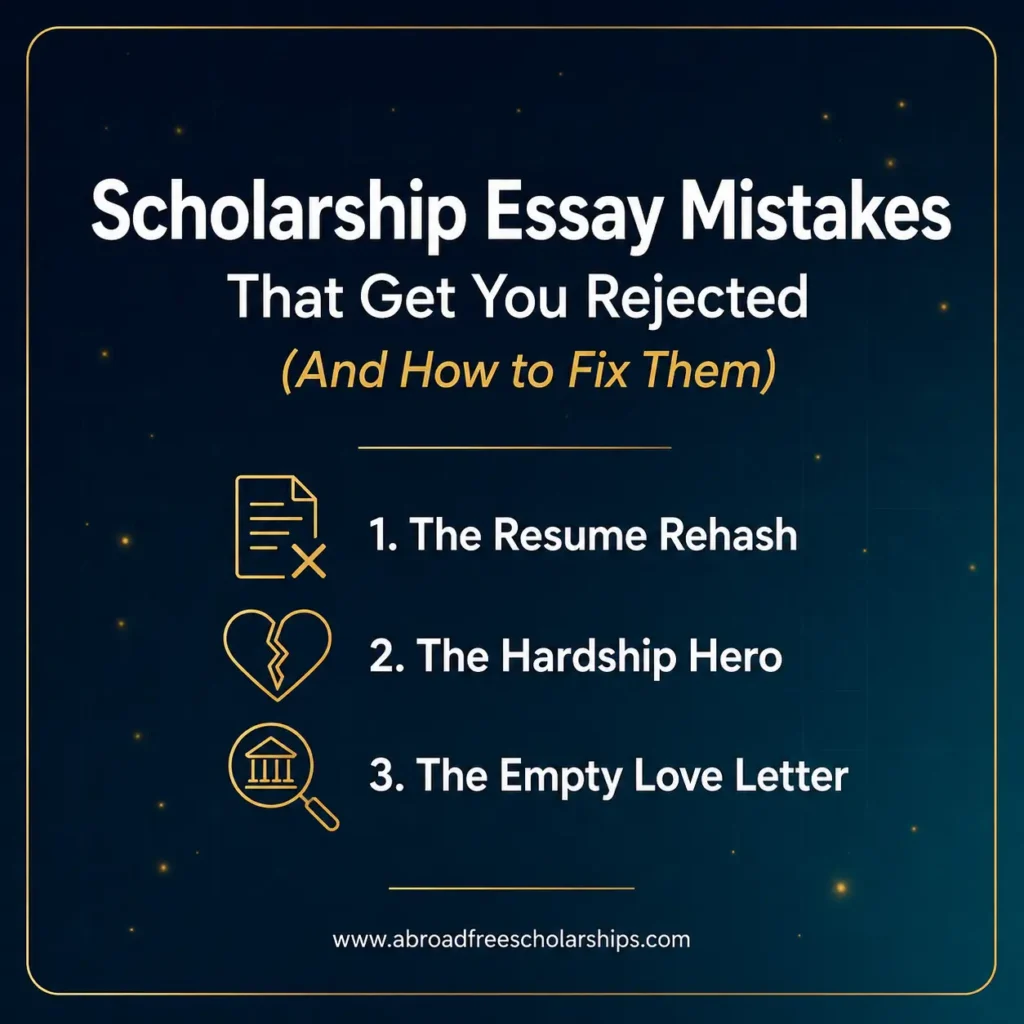
Mistake 1: The Resume Rehash (Letting Numbers Do the Talking)
The Pitfall
When you’ve worked hard for your stats—the GPA, the class rank, the part-time job hours—it feels almost reckless not to lead with them. The fear is immediate: “If I don’t tell them I’m a high achiever right away, how will they know I’m serious?” So you open the essay like a human CV, listing metrics as a proof of worth.
Review committees flag this immediately, not because they dislike accomplishment, but because a list of achievements tells us zero about your decision-making, your curiosity, or your self-awareness. Scholarships are bets placed on people, not spreadsheets. If your essay could belong to any other high-performing student in your school, you’ve made yourself interchangeable. And interchangeable candidates get rejected, no matter how shiny the numbers are. The essay’s true job is to explain what those experiences did to the way you think.
The Weak Example (Before)
“My name is Sara and I have maintained a 3.9 GPA while working 25 hours a week. I am in the top 5% of my class and have received the Principal’s Award for three consecutive semesters. I also volunteered at a local hospital and was captain of the debate team. These achievements demonstrate my strong work ethic and time-management skills, which is why I believe I am a deserving candidate for this scholarship.”
It’s honest. It’s also completely hollow. We don’t see Sara, only a series of verified tasks. The word “deserving” even subtly reduces the scholarship to a prize for past behavior rather than an investment in a future leader.
The Strategic Fix
Step 1: Highlight Every Generic Statement and Replace It with Specific Proof
Take phrases like “strong work ethic” or “time-management skills” and ask: What specific moment proves this? Keep only the proof, not the label. Your goal is to show the action, not the adjective.
Step 2: Pick One Resume Entry That Has an Untold Story
Often the most humble line—the part-time cashier gig, the family responsibility—contains your voice. Find the single experience that made you think differently, even if it felt ordinary at the time.
Pro Tip: Look for the Frustration
Moments of quiet frustration (a broken process, a repeatedly ignored problem) are goldmines. They reveal an observant, critical mind—exactly what scholarship committees want to fund.
Step 3: Connect That Experience to a Question You Can’t Stop Thinking About
Articulate the intellectual hunger that the experience sparked. Don’t just say “I’m passionate about public health.” Show the exact puzzle you noticed: “Why did the WIC vouchers keep getting declined?” This is the seed of your academic curiosity.
Step 4: End with a Forward-Facing Insight, Not a Backward Summary
Close the paragraph by showing how this experience reshaped your future ambitions. Make the reader feel that the scholarship is the logical next chapter, not a trophy for the past.
The Winning Extract (After)
“Working Friday night shifts at the grocery store, I started noticing that the same WIC vouchers would sometimes be declined because of a mismatch between the approved list and the store inventory system. I wasn’t the manager, just the cashier, but I started keeping a sticky note tally of the most common errors. By the end of the month, I’d built a cheat-sheet that cut the rejection rate at my register to almost zero. That tiny fix sparked something I now want to study properly: how administrative systems can unintentionally penalize the families they’re designed to help. I’m applying for this scholarship to bring that question into public policy classrooms, not just the checkout aisle.”
Notice: no GPA, no award titles. Yet we immediately trust this person’s work ethic, initiative, and intellectual drive. The scholarship feels like a necessary next chapter, not a reward for past perfection.
The Mindset Shift
You are not a collection of metrics; you are a pattern-noticer, a problem-solver, a future colleague. Lead with the pattern you noticed.
Mistake 2: The Hardship Hero (Pain Without Progress)
The Pitfall
If you’ve endured genuine hardship, you may feel a heavy pressure to make it the center of your essay. The fear is logical: “If I don’t share how hard it’s been, they’ll never understand what I overcame to get here.” So you write the story of your suffering in painstaking detail, assuming that intensity of difficulty proves strength.
Committees reject these essays—heartbreakingly, often—because they mistake resilience for a passive endurance of pain. When the essay ends with “and that’s why I’m worthy,” the applicant has cast themselves as a victim of circumstance, not an agent of change. Scholarship foundations are not charities searching for the saddest story; they’re looking for changemakers who will wield their education to solve problems. Describing a storm tells us about the weather. We need to see how you built the boat.
The Weak Example (Before)
“My father lost his job when I was fourteen, and we lost our house. I cried myself to sleep for months, listening to my parents argue about money. I often skipped meals and went to school in worn-out shoes, humiliated by the whispers. Despite all the suffering, I refused to give up. I know what it’s like to have nothing, and that pain has made me strong. This scholarship is my only escape from the cycle of poverty.”
The visual details are vivid, but the applicant remains frozen inside the pain. Phrases like “refused to give up” and “has made me strong” are conclusions we’re told to accept, not growth we witness. The word “escape” suggests running from something, not building toward a specific future.
The Strategic Fix
Step 1: Cut the Pain Description to a Maximum of Two or Three Lines
The reader only needs enough context to understand the stakes. More than that tips into trauma exhibition, which can distance the committee instead of connecting them to your resilience.
Step 2: Pivot Immediately to a Specific Action You Took, No Matter How Small
Did you translate documents for a parent? Organize a neighborhood babysitting co-op? Start selling sketches? Action is the seed of agency. A fifteen-year-old navigating benefit portals shows far more about your character than pages of suffering.
Remember: Tiny Actions Carry Immense Weight
You don’t need a grand achievement. The act of creating a simple spreadsheet to track family expenses, or learning to fill out a complicated form to help a parent, proves resourcefulness far more than a generic claim of “perseverance.”
Step 3: Articulate the Exact Skill or Belief That Action Forced You to Develop
Go beyond “I learned to be strong.” Did you learn to negotiate? To research local aid with no guidance? To communicate across cultural fear? Name the skill precisely, because that skill is what you will bring to the university.
Step 4: Tie That Skill Directly to an Academic Goal and the Scholarship’s Mission
Show that the hard years didn’t just give you pain—they gave you a uniquely qualified perspective that a university needs. Connect the skill you built to a specific major, research area, or community initiative the scholarship supports.
The Winning Extract (After)
“When my father lost his job, I became the household translator—not of language, but of bureaucracy. I was fifteen, navigating the online portals for housing assistance and SNAP benefits while my parents sat beside me, exhausted and embarrassed. I learned to ask questions in the specific way the forms demanded, to anticipate rejections and prepare appeal documents in advance. That experience didn’t just teach me patience; it taught me that systems often hide their humanity behind paperwork. I’m applying for this scholarship to study social work and policy, because I want to design intake processes that feel like a doorway, not a test—a goal directly aligned with your foundation’s mission of equitable community access.”
The suffering is acknowledged, but the spotlight is on the applicant’s resourcefulness and vision. The committee now sees someone who will actively use the scholarship, not just be saved by it.
The Mindset Shift
You are not your trauma. You are the person who responded to that trauma with ingenuity. Show the response, not just the wound.
Mistake 3: The Empty Love Letter (Flattery Without Fit)
The Pitfall
You desperately want them to know you’ve done your homework. The fear is, “If I don’t sound impressed by this institution, they’ll think I’m not serious about attending.” So you fill the essay with glowing adjectives about the university’s “world-class faculty,” “vibrant campus,” and “unparalleled opportunities.”
Review committees roll their eyes at generic flattery because they’ve seen the same sentences swapped into hundreds of essays for different schools. It signals that you’ve skimmed the website’s “About” page, not that you’ve genuinely imagined yourself there. Worse, it wastes precious word count that should explain your specific academic identity. A scholarship is a relationship, not a fan letter.
The Weak Example (Before)
“I am applying for this scholarship at Prestige University because of its outstanding reputation and commitment to academic excellence. The beautiful campus and diverse student body create an inspiring environment. I have long admired the distinguished faculty and know that studying here would be a dream come true. With this scholarship, I will be able to take advantage of everything the university has to offer.”
Every sentence could describe literally any university on Earth. There is no evidence of curiosity, no named intellectual interest, and the phrase “take advantage of everything” is a passive consumer’s stance, not a potential contributor’s.
The Strategic Fix
Step 1: Research One Specific Academic Resource by Its Exact Name
Find a named lab, a particular course, a professor’s published paper, a library archive, or a student-led initiative. Write down the exact name—specificity is your credibility engine.
Step 2: Draw a Direct Link Between That Resource and Your Own Prior Experience
Don’t just say you’re interested in a topic. Show the bridge: “Because I did X in my own community, I see that Y Professor’s work on Z would help me develop a necessary skill or answer an urgent question.”
Make It a Conversation, Not a Compliment
Imagine you’re writing to a future collaborator. You wouldn’t just praise their reputation; you’d mention the specific problem you want to solve together. That’s the energy committees crave.
Step 3: Explain What You Would Contribute, Not Just What You Would Take
Scholarship committees love seeing how you’d be an active participant. Mention the dataset you’d bring, the community project you’d evolve, or the perspective you’d add to classroom discussions.
Step 4: Mirror the Scholarship’s Own Mission Language Through Your Concrete Goal
Use the program’s stated values (e.g., “technology for social equity,” “ethical leadership”) but only as they authentically intersect with your story. This shows alignment without flattery.
The Winning Extract (After)
“After two years of organizing a weekend coding club for middle-school girls in my town, I’ve hit a wall: I know how to teach Scratch, but I don’t yet know how to measure whether early interventions actually close long-term gender gaps in STEM. I’m applying for this scholarship because I want to work with Dr. Elena Ruiz, whose research on computational thinking in adolescents directly addresses that question. Her course ‘Education and Data Justice’ aligns perfectly with the Stevenson Scholarship’s commitment to technology for social equity. I’m not just coming to learn; I’m coming with a dataset and a group of students whose outcomes I want to track formally, and I need the methodological tools your program offers to do it responsibly.”
This applicant didn’t praise the campus. They showed up on the page already working on a problem, and they identified exactly how this scholarship would accelerate their ability to solve it. That’s the difference between an admirer and a future colleague.
The Mindset Shift
You are not an applicant begging for a seat; you are a problem-solver seeking the right toolkit. Name the toolkit and the problem you’ll solve with it.
You Already Have the Material—Now Stop Hiding It
A weak draft doesn’t mean you’re a weak candidate. It just means the real you—the one who problem-solves in grocery stores, translates bureaucracies, or teaches girls to code—hasn’t hit the page yet. Every fix above starts with the same step: trust that the small, specific, action-filled truth of your life is far more compelling than any attempt to sound “impressive.” You already have the material. Now you just get to stop hiding it.