
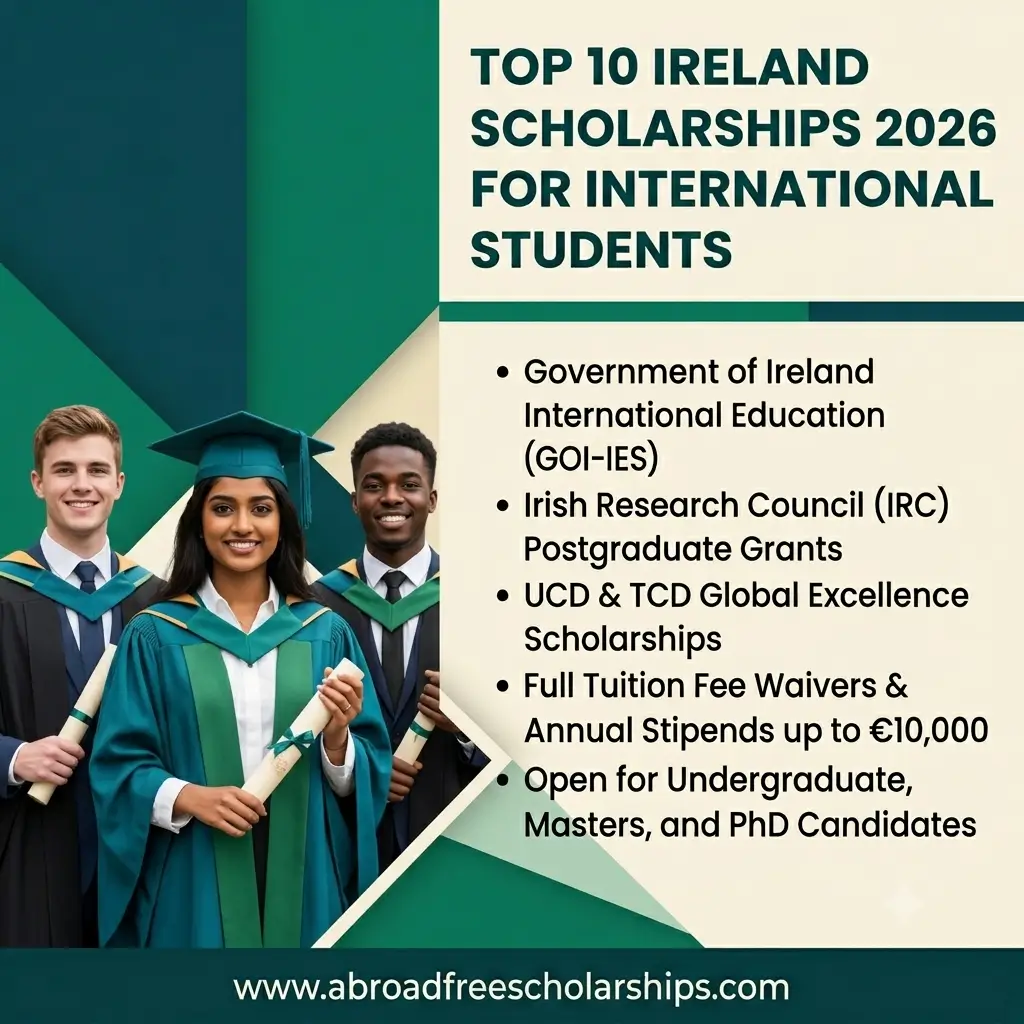
Major scholarship programs available for international students to study in Ireland in 2026. It highlights opportunities that cover undergraduate, graduate, and PhD degree funding through Irish universities or government‑sponsored scholarships. The page also briefly explains that these scholarships help cover tuition fees, living expenses, and other costs in Ireland.
🎓 Top 10 Universities / Institutions Mentioned
Below are the 10 universities or higher‑education bodies associated with those scholarships, along with a short detail and official website link:
- University College Dublin (UCD) – A leading research‑intensive university in Ireland, ranked among the top 1% globally, offering a wide range of undergraduate, postgraduate and research programs.
🔗 https://www.ucd.ie/ - National University of Ireland, Galway (NUI Galway / University of Galway) – A comprehensive university with strong academic programs across arts, sciences, business, and engineering.
🔗 https://www.universityofgalway.ie/ - Maynooth University – A recognized Irish university offering undergraduate and postgraduate degrees, known for its close‑knit community and research initiatives.
🔗 https://www.maynoothuniversity.ie/ - University of Galway (NUI Galway) – (Same broad institution as above) Focuses on strong education and research across various disciplines.
🔗 https://www.universityofgalway.ie/ - Dublin City University (DCU) – A modern Irish public university emphasizing innovation, enterprise, and international engagement.
🔗 https://www.dcu.ie/ - University of Limerick (UL) – Known for incorporating work‑integrated learning and offering degrees in sciences, arts and business.
🔗 https://www.ul.ie/ - Royal College of Surgeons in Ireland (RCSI) – A specialized medical and health sciences university with an international focus.
🔗 https://www.rcsi.com/ - Trinity College Dublin (The University of Dublin) – Ireland’s oldest university (founded 1592), offering broad programs and strong international reputation.
🔗 https://www.tcd.ie/ - Grattan Institute / Scholarships – While not a university itself, the Grattan Scholarships are tied to academic opportunities (often associated with university programs, e.g., Trinity College Dublin or other research bodies).
🔗 (Scholarship info rather than university link – typically hosted on university sites) - Generation Study Abroad Scholarships – This is a scholarship program in partnership with Trinity College Dublin and external partners; not a distinct university but associated with study at Irish universities like Trinity College Dublin.
🔗 Visit main Trinity site: https://www.tcd.ie/
1. Step-by-Step Application Guide Based on Successful Applicant Experiences
Many successful applicants to Ireland scholarships report that early preparation and careful attention to documentation significantly improve their chances of selection. The following process reflects common practices used by scholarship recipients.
- Research Suitable Scholarships: Compare scholarship benefits, eligibility criteria, deadlines, and participating universities.
- Secure Admission First: Most major Irish scholarships require applicants to obtain a conditional or final admission offer from an eligible Irish institution before submitting the scholarship application.
- Prepare Academic Documents:
- Academic transcripts
- Degree certificates
- Passport copy
- English language proficiency proof
- Updated CV/Resume
- Write a Strong Motivation Letter: Clearly explain your academic goals, career objectives, and reasons for selecting Ireland as your study destination.
- Request Recommendation Letters Early: Contact professors or employers at least one month before the application deadline.
- Submit Scholarship Application Carefully: Review every section, verify uploaded documents, and ensure all information matches your admission application.
- Monitor Application Status: Regularly check your email and scholarship portal for updates, interview invitations, or requests for additional documents.
- Prepare for Interviews (If Required): Practice answers related to leadership, academic achievements, future plans, and contribution to your home country.
2. Common Mistakes to Avoid When Applying for Scholarships
Many otherwise qualified candidates are rejected because of avoidable errors. Consider the following precautions before submitting your application.
- Submitting applications close to the deadline.
- Using the same generic motivation letter for multiple scholarships.
- Ignoring scholarship-specific eligibility requirements.
- Uploading incomplete or low-quality documents.
- Providing inconsistent information between university and scholarship applications.
- Failing to demonstrate leadership, community involvement, or extracurricular achievements.
- Not proofreading essays and application forms.
- Missing recommendation letter deadlines.
- Overlooking interview preparation.
- Failing to explain future career impact and contribution to society.
Expert Tip: Scholarship reviewers often assess not only academic excellence but also leadership potential, future impact, and commitment to contributing to local or global communities.
3. Tips for Writing a Strong Motivation Letter for Ireland Scholarships
A motivation letter is one of the most influential components of a scholarship application. Selection committees use it to understand your ambitions, achievements, and suitability for the award.
Recommended Structure
- Introduction: Briefly introduce yourself and state the scholarship you are applying for.
- Academic Background: Highlight relevant achievements, research experience, projects, or awards.
- Why Ireland: Explain why Ireland’s education system, research environment, or specific university aligns with your goals.
- Career Objectives: Describe your short-term and long-term professional plans.
- Impact Statement: Explain how the scholarship will help you contribute to your community, industry, or country after graduation.
- Conclusion: Reinforce your commitment and appreciation for the selection committee’s consideration.
Best Practices
- Use clear and professional language.
- Provide specific examples rather than general statements.
- Keep the letter focused and concise.
- Show leadership qualities and social impact.
- Demonstrate genuine interest in the chosen program.
- Proofread carefully before submission.
4. How to Get an Accommodation Voucher as an International Student
Accommodation support varies by university and scholarship program. While not all scholarships provide accommodation vouchers, students can increase their chances of receiving housing assistance by following these steps.
- Apply Early: University accommodation often operates on a first-come, first-served basis.
- Accept Your Admission Offer Promptly: Some housing benefits become available only after enrollment confirmation.
- Check International Office Announcements: Universities frequently release accommodation grants, discounts, and voucher programs for international students.
- Contact Student Housing Services: Ask about:
- Accommodation vouchers
- Housing discounts
- Welcome grants
- Residence hall promotions
- Apply for Financial Need-Based Support: Some institutions offer additional housing assistance to students demonstrating financial need.
- Attend Pre-Arrival Webinars: Universities often share housing opportunities and special accommodation offers during orientation events.
- Monitor Scholarship Emails: Additional housing support may be announced after scholarship selection.
Important: Accommodation assistance policies differ among universities, so applicants should always consult the official housing office for current opportunities.
5. Complete Breakdown of the MTCP Interview Process
Note: The Malaysia Technical Cooperation Programme (MTCP) scholarship occasionally includes an interview stage depending on the selection cycle and country-specific procedures. Candidates should always verify the latest requirements through official announcements.
Stage 1: Initial Screening
- Academic qualifications review
- Document verification
- Eligibility assessment
- Scholarship application scoring
Stage 2: Interview Invitation
Shortlisted applicants receive an invitation via email containing interview details, schedule, and instructions.
Stage 3: Interview Session
The interview is generally conducted online and may last between 15 and 30 minutes.
Common Interview Topics
- Personal introduction
- Academic achievements
- Leadership experience
- Professional background
- Reasons for choosing the program
- Reasons for selecting the host country
- Career goals after graduation
- Contribution to home-country development
Stage 4: Competency Evaluation
Interviewers typically assess:
- Communication skills
- Academic readiness
- Leadership potential
- Problem-solving ability
- Future impact and career vision
- Cultural adaptability
Stage 5: Final Selection
After interviews, candidates are ranked according to overall application strength, interview performance, academic merit, and alignment with scholarship objectives.
Interview Preparation Tips
- Research the scholarship thoroughly.
- Review your application documents.
- Practice concise answers.
- Prepare examples demonstrating leadership and impact.
- Dress professionally for virtual interviews.
- Maintain a stable internet connection.
- Show confidence, authenticity, and clear career direction.